

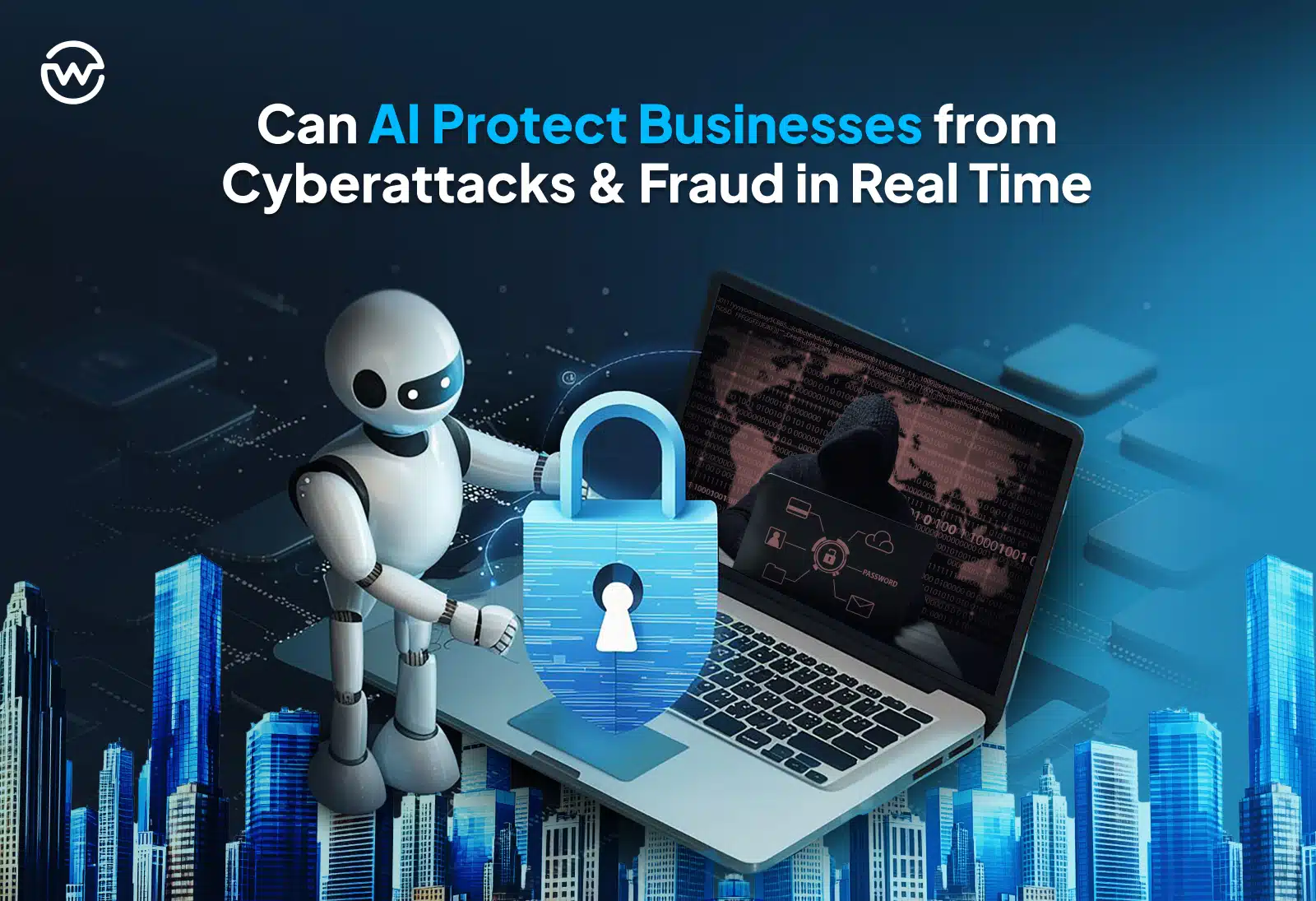
Can AI Protect Businesses from Cyberattacks and Fraud in Real Time?
Category : Artificial intelligence / by Andrew
The technological revolution has brought forth various innovations that have not only been appreciated but are also being adopted by different industries to improve their business models. Yet, no matter how revolutionary these developments are, they still, to some extent, leave room for vulnerabilities. This makes business models prone to cyberattacks and fraud.
Technical developments are indeed crucial and have become an integral part of business frameworks, but dealing with vulnerabilities is still the biggest challenge.
Breaking away from corporate jargon, Artificial Intelligence has become one of the most intriguing innovations of all time. AI offers numerous possibilities to improve business systems with automation, predictive analysis, informed decision-making, and much more, leveraging large datasets and sophisticated algorithms.
But there’s more. Technology specialists, particularly those dealing with cybersecurity, are exploring the use of AI Solutions to protect businesses from cyberattacks and fraud in real time. But is that really possible? Can the biggest challenge of current times be addressed by AI? Let’s find out.
Also Read: Can Blockchain and AI Work Together?
AI in Cybersecurity Explained
Artificial Intelligence can help safeguard business data, systems, and networks from cyberattacks and fraud. AI’s core functionality of processing and analysing massive datasets and automating decision-making works similarly in cybersecurity.
AI solutions can assist in cybersecurity efforts by examining vast amounts of information within a business’s technological ecosystem and identifying potential risks through algorithms. Once these risks are detected, AI can provide quicker responses for more accurate decision-making.
AI Technologies Powering Cybersecurity and Fraud Detection
Artificial Intelligence development relies on several core technologies, including machine learning, deep learning, natural language processing, and predictive analytics, to protect from cyberattacks and fraud:
Machine Learning
Machine learning enables business systems to analyse past patterns of cyberattacks and gain insights from them. This allows similar patterns to be quickly recognised in the future.
Deep Learning
Deep learning, a subset of machine learning, is designed to process and analyse highly complex and massive datasets. It can help detect threats that often go unnoticed by traditional technologies.
Predictive Analytics
Predictive analytics is an advanced form of analytics that assists in examining fraud patterns and detecting them even before they actually happen.
Natural Language Processing (NLP)
NLP enables the detection of patterns in unstructured datasets such as chat messages, social media engagements, emails, reports, and more. It is highly effective for detecting unusual behaviour in language patterns and extracting important threat information.
Applications of AI in Cybersecurity and Real-Time Fraud Detection
AI applications in cybersecurity cover different aspects of protecting business systems, including fraud detection, risk adaptation, access control improvement, and more. Here’s how:
Network Threat Detection
Previous threat detection technologies were somewhat useful in recognising and flagging known patterns, but often failed to identify new ones. AI-powered detection has overcome this by identifying unusual patterns using both data analytics and machine learning.
Additionally, it employs anomaly detection to identify even the slightest potential threats. The combined use of Intrusion Detection Systems (IDS) and Intrusion Prevention Systems (IPS) works best for monitoring network traffic and blocking suspected threats.
As a result, AI can be employed to detect signs of anomalies, data breaches, hacks, and malware infections in real time. This timely response allows businesses to act swiftly and prevent system failures.
Behavioural Analytics and Insider Threats
History shows that many cyberattacks were carried out by someone within the organisation. These could be intentional, such as exploiting insider knowledge, or unintentional, such as accidental misuse of business data. Insider attacks are often the most difficult to spot and halt in time.
AI has proven to be extremely effective in identifying these internal threats by leveraging behavioural analytics. This involves building employee profiles and analysing access to sensitive internal data to model behaviour. It helps identify anomalous activity and flags it for further examination.
Endpoint Security
Endpoint security protects end-user devices such as laptops, phones, computers, and servers connected to a network from malicious activity. Both machine learning and advanced algorithms are used to analyse and detect threats. Thus, AI has proven useful in endpoint protection by detecting ransomware, malware, viruses, and other threats.
Fraud and Anomaly Detection
Financial information is critical for every business, as it involves sensitive data and transactions. Businesses operating in the financial sector, as well as those handling financial transactions in other industries, can be effectively protected using AI. AI-powered tools continuously monitor platforms, looking for unusual transactions or suspicious activity.
Use Cases of AI in Cybersecurity and Fraud Detection Across Industries
- E-commerce Platforms: Online retailers often face account takeover issues, resulting in heavy losses. AI helps secure their systems by analysing user activity, checking locations, and automatically blocking suspicious login attempts.
- Financial Services: Remittance platforms, banks, fintech companies, and other institutions use AI to identify unusual user behaviour based on transaction details and login patterns. For example, if a user transfers an unusually large amount of funds, AI models can detect and block such transactions.
- Healthcare and Pharmaceuticals: In healthcare, AI models are integrated into management systems to detect phishing attempts. For example, AI-driven email filtering tools can flag phishing emails as spam to prevent credential theft and protect sensitive data.
- Manufacturing: The manufacturing industry relies on complex systems that are prone to attacks. To address this, manufacturers use AI-based anomaly detection to identify threats and prevent disruptions in supply chain operations or equipment damage.
Potential Risks of AI Integration in Business Infrastructure
AI not only protects businesses but also comes with risks and vulnerabilities:
- Attackers may target AI models, manipulating their architecture and affecting performance.
- Since AI depends on data, compromised or altered data can undermine its effectiveness.
- Cybercriminals can exploit vulnerabilities in AI algorithms, leading to inaccurate predictions.
- Unethical practices during AI development can result in privacy violations, harming credibility.
- AI models can become less efficient over time and require regular updates and maintenance.
- Noncompliance with regulatory requirements such as GDPR, AML, and KYC can lead to data misuse and legal penalties.
Wrapping Up
AI is highly effective in addressing the long-standing challenges businesses face with cybersecurity and fraud. Yet, it’s important to acknowledge that AI integration also carries risks. With the right development approach, AI can be leveraged to prevent cyberattacks and fraud in real time.
If you are a business looking to secure your technological infrastructure with AI, we can help. Webcom Systems is a pioneering AI Development Company that has assisted organisations across industries in enhancing their security through AI solutions. Our team of 200+ experts is ready to support you with custom AI integration into your cybersecurity strategy. Get in touch today to protect your business ecosystem from cyberattacks and fraud.
Also Read: Artificial Intelligence and Blockchain Integration In Business
Related Posts
Webcom Systems Pty Ltd is a technology development and consulting company that builds blockchain, Web3, digital currency, NFT, DeFi, remittance, and related software solutions. Our role is strictly limited to providing software development, technical architecture, and strategic consulting services. We do not provide financial, investment, brokerage, exchange, asset management, taxation, legal, or trading services to businesses or individuals. We do not operate financial institutions, manage client funds, execute trading operations on behalf of users, or offer investment, tax, or legal advice of any kind.
Any legal compliance, license, regulatory approval, government registration, permit, KYC/AML implementation, and any other statutory obligation must be obtained and managed entirely by the client. Webcom Systems Pty Ltd does not assist in obtaining licenses or regulatory approvals from any authority.
All information provided on our website, marketing materials, proposals, and communications is for general informational purposes and does not contain investment, legal, or financial advice specific to you. You may rely on this information strictly at your own risk. No particular piece of information issued by us constitutes a proposal or request for a proposal to invest. We do not recommend, endorse, or sponsor any assets, securities, companies, or funds.
Clients are entirely responsible for conducting independent due diligence and are professionally advised to seek assistance from licensed financial advisors, legal counsel, and regulatory professionals to make such critical choices. Webcom Systems Pty Ltd accepts no liability for any decisions or financial consequences of your investment decisions.
Risk WarningInvesting and trading in financial markets involve a high level of risk. The value of financial products may fluctuate significantly, and you may lose part or all of your invested capital. It is preferable to fully comprehend how different financial products work before making any investment decisions. You should also carefully evaluate your financial situation, investment goals, and risk tolerance, and consider all risks involved before investing.
Error: Contact form not found.