

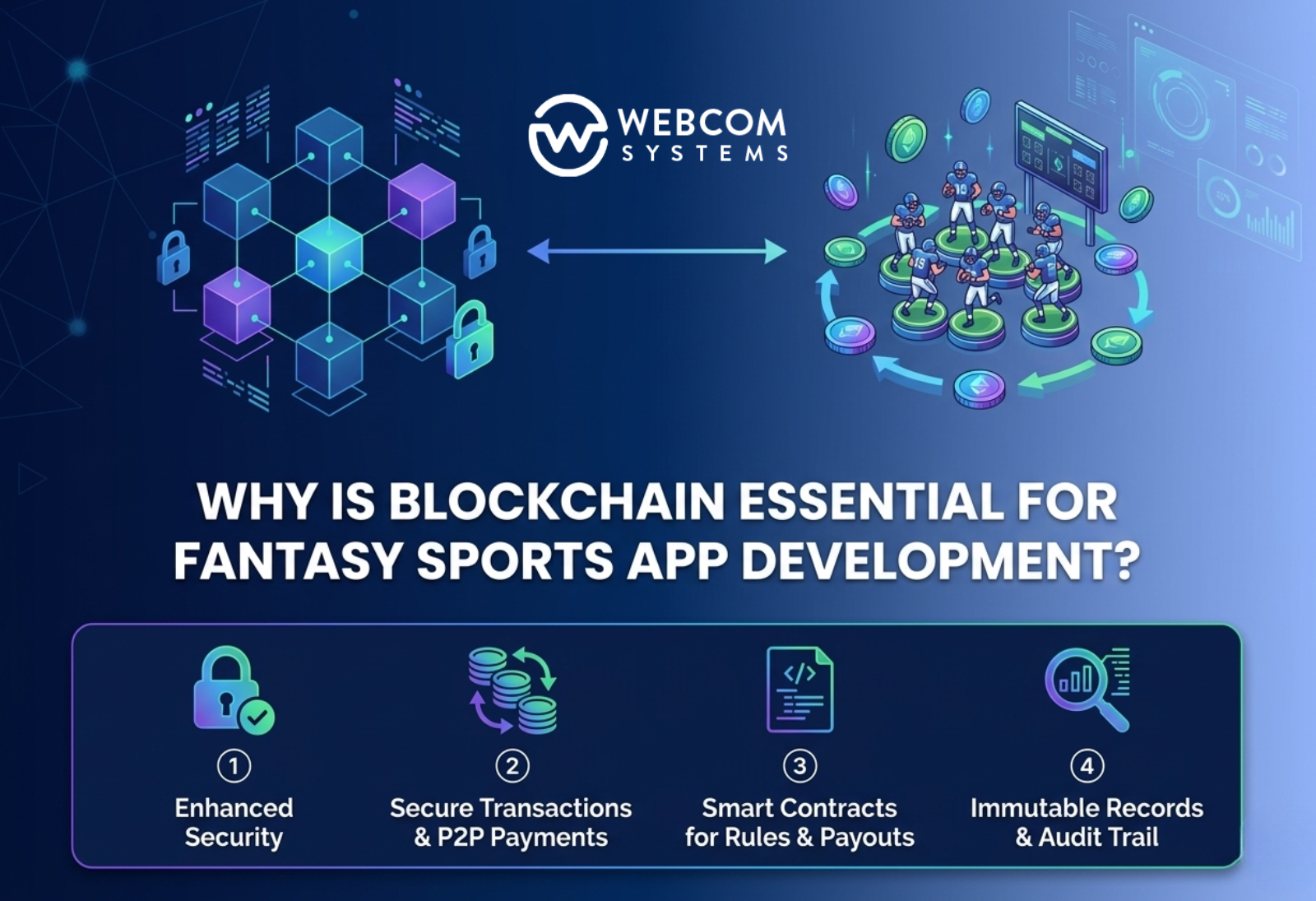
Why Is Blockchain Essential for Fantasy Sports App Development?
Category : Blockchain / by Andrew
The sports industry is one of the few multi-trillion-dollar markets that thrives on excitement, entertainment, passion, and the emotions of worldwide fans. Forking out of this lucrative industry, fantasy sports has emerged as a rapidly growing segment, with a market size of around USD 42.37 billion in 2026.
Fans are turning to fantasy sports apps to level up their experience, from just watching their favourite games to actively participating and making their passion pay off. Clearly, these apps exactly deliver what an actual sports fan would enjoy and even get value from.
But! There are some issues with these fantasy sports game apps around fairness that make it tough for fans to put their trust in them. And this is where blockchain technology took its place in this industry. Sticking true to its nature, this transformative technology not only closes the loopholes in fantasy sports but also opens up new possibilities. Read on to find out how.
Also Read: What Industries Benefit Most From RWA Tokenization Development?
Challenges With Traditional Fantasy Sports App Development
As is obvious, before getting into what blockchain is doing to improve the fantasy sports industry, one needs to know what the true need is.
So, let’s first go through the issues with traditional fantasy sports platforms. For starters, traditional fantasy sports apps are mostly centralised. Now, what this means is that the platform owner has complete control over databases, scoring systems, transactions, payouts, and every single aspect related to the app. This system certainly works and is not the main concern, but it creates trust issues among users. Here’s how:
- Limited Transparency: There is a poor level of transparency in Fantasy Sports Apps. Users frequently have no idea how scores are calculated or winners selected.
- Slow Payments: As these apps rely on banking and manual verification systems, they take several days to process payments.
- Security Concerns and Fraud Risks: Security issues stem primarily from the inherent flaws of centralised databases. They are more sensitive to hacking, fake accounts, and data manipulation.
- Conflict Complications: Using legacy systems, these gaming companies struggle to keep accurate records of all platform transactions. This leads to payout disputes with users.
- Limited Ownership: Game rewards give users limited ownership rights. They do not actually own in-game assets, collectibles, or fantasy player cards.
- Manipulation Risks: Unreliable platforms misuse their authority to control prizes, competitions, and other aspects of gaming, leading to unfair gameplay.
- Geographic Restrictions: Global participation is limited by the regulatory environment and conventional payment methods.
Understanding Blockchain in Fantasy Sports
Blockchain in gaming is not merely a concept; it’s actually a reality and is making a big difference. In 2026, the blockchain gaming market is estimated to be around USD 279.10 billion, and by 2034, it is expected to surpass USD 1,351.87 billion. Particularly, in fantasy sports, blockchain is causing major ripples.
Blockchain technology uses a decentralised digital ledger to keep track of every transaction shared across the nodes of computers. In fantasy sports applications, blockchain can be used to record user entries, team selections, match scores, reward distributions, NFT ownership, payments, and all other operational and financial transactions.
Thus, every app activity can be easily tracked and verified by all the authorised parties. Besides, blockchain-based smart contracts automate all the transactions, secure payments, and protect data integrity.
Key Reasons Blockchain Is Essential for Fantasy Sports App Development
Blockchain’s capabilities work together to address the most pressing industry issues and transform the landscape of fantasy sports. Several gaming companies are already embracing the power of blockchain in fantasy sports and sports entertainment, such as Sorare, DraftKings, NBA Top Shot, Chiliz, and many more.
Here are the ways blockchain solutions help fantasy sports apps, making them an essential part of app development:
Decentralised Ecosystem Builds Trust
There is no centralised authority that handles the platform activities in these fantasy sports apps. Blockchain manages operations by sharing data collectively across a network rather than by a single organisation.
This decentralisation in fantasy apps reduces dependency on intermediaries and improves accountability. Hence, it benefits app users by providing honest gameplay while also increasing the platform’s market credibility.
Improved Transparency
Transparency is the key benefit of integrating blockchain technology in fantasy sports apps. The distributed ledger records all the transactions, such as team selections, score determination, results, and prize awards. As users can check and verify these details anytime, this makes fantasy sports app contests more fair and the results more authentic.
Increased Security and Fraud Prevention
Fantasy sports app users share their sensitive personal and financial details when they download the app. Thus, even minor breaches often jeopardise financial data and the platform’s reputation.
But the blockchain integration improves security massively. Its decentralised architecture by design provides cryptographic security and distributed data storage. This helps to protect data against unauthorised access and eliminates the possibility of a single point of failure.
This is why blockchain can be used to permanently prevent security issues in fantasy sports apps, such as hacking, fake accounts, identity fraud, data manipulation, and unauthorised transactions.
Smart Contracts Automation
Smart contracts are basically digital agreements that are coded with their term of execution to automate certain transactions. In fantasy sports apps, smart contract development allows automating user verification, reward distribution, bonus calculations, etc.
This automation removes the need for manual intervention to eventually cut down on operating costs and also eliminates the possibility of human errors.
Quick Payments And Global Accessibility
Blockchain-powered fantasy sports apps usually carry crypto and digital asset payments. These transactions are of a peer-to-peer nature and, unlike banking transactions, are free from currency conversion fees, regional banking restrictions, and, of course, payment delays.
This allows users to make faster deposits, receive instant rewards, and have smoother withdrawal experiences. Additionally, blockchain eliminates geographical payment barriers and makes cross-border participation easier. Hence, worldwide users can join fantasy contests and receive payouts.
New Revenue Opportunities For Gaming Companies
By incorporating blockchain, businesses aren’t restricted to traditional advertisements or subscription plans. They can earn through multiple monetisation channels on their fantasy sports apps, such as NFT marketplace commissions, Token sales, Transaction fees, Premium collectibles, etc.
Challenges of Blockchain in Fantasy Sports App Development
Although blockchain offers many advantages, that doesn’t mean challenges don’t exist at all. Here are some of the challenges when it comes to blockchain integration in sports app development:
- Blockchain is secure, but poorly written smart contracts often expose fantasy sports platforms to security risks and financial losses. That’s why the expertise of blockchain developers matters a lot in these app development projects.
- Blockchain development is often more expensive than basic app development due to the use of specialised technologies. However, ROI for blockchain app development is higher as well.
- Fantasy sports regulations vary across countries. Thus, it becomes difficult to manage complex compliance across different jurisdictions.
- Blockchain networks cause congestion, which leads to slower transaction speeds and higher fees during peak periods. However, using layer 2 solutions helps to overcome this problem.
Build Next-Gen Blockchain-Powered Fantasy Sports App With Webcom Systems
In 2026, the world is recognising the blockchain’s potential to solve some of the industry’s biggest problems. Even modern users place their trust in blockchain-powered fantasy sports apps, which have made them indispensable for fantasy sports app development.
If you are also looking to build your own fantasy sports app featuring a blockchain-based architecture, Webcom Systems can help you with that. We are a top Blockchain Development Company in Australia, specialising in developing high-performance blockchain-powered fantasy sports apps for global gaming firms. With the fun of immersive gameplay and transparency, security, and multiple monetisation opportunities presented by decentralised architecture, our apps are designed to thrive in the fantasy sports industry.
Whether you want to launch a fantasy cricket app, a football fantasy platform, an NFT-based sports ecosystem, or something else, contact Webcom Systems today for expert fantasy sports app development services.
Also Read: How Will Stablecoins Transform Cross-Border Payments in 2026?
Related Posts

Webcom Systems Pty Ltd is a technology development and consulting company that builds blockchain, Web3, digital currency, NFT, DeFi, remittance, and related software solutions. Our role is strictly limited to providing software development, technical architecture, and strategic consulting services. We do not provide financial, investment, brokerage, exchange, asset management, taxation, legal, or trading services to businesses or individuals. We do not operate financial institutions, manage client funds, execute trading operations on behalf of users, or offer investment, tax, or legal advice of any kind.
Any legal compliance, license, regulatory approval, government registration, permit, KYC/AML implementation, and any other statutory obligation must be obtained and managed entirely by the client. Webcom Systems Pty Ltd does not assist in obtaining licenses or regulatory approvals from any authority.
All information provided on our website, marketing materials, proposals, and communications is for general informational purposes and does not contain investment, legal, or financial advice specific to you. You may rely on this information strictly at your own risk. No particular piece of information issued by us constitutes a proposal or request for a proposal to invest. We do not recommend, endorse, or sponsor any assets, securities, companies, or funds.
Clients are entirely responsible for conducting independent due diligence and are professionally advised to seek assistance from licensed financial advisors, legal counsel, and regulatory professionals to make such critical choices. Webcom Systems Pty Ltd accepts no liability for any decisions or financial consequences of your investment decisions.
Risk WarningInvesting and trading in financial markets involve a high level of risk. The value of financial products may fluctuate significantly, and you may lose part or all of your invested capital. It is preferable to fully comprehend how different financial products work before making any investment decisions. You should also carefully evaluate your financial situation, investment goals, and risk tolerance, and consider all risks involved before investing.
Error: Contact form not found.