

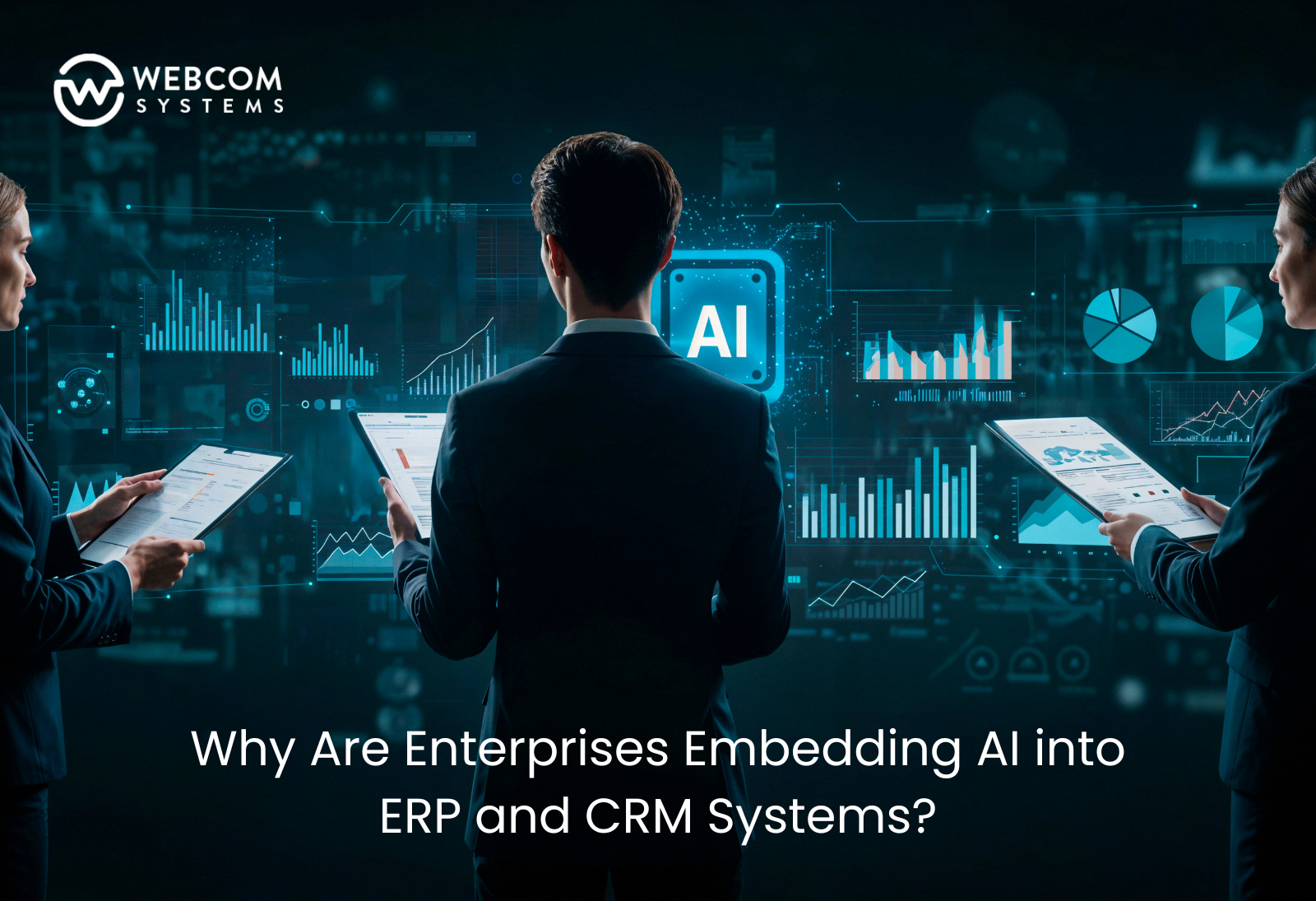
Why Are Enterprises Embedding AI into ERP and CRM Systems?
Category : Artificial intelligence / by Andrew
AI surged as a big wave, expected by many to be just another cool tech trend, but it has become the biggest phenomenon of this decade. Instead of pursuing fixed trails, AI is advancing universally and permeating across almost every single vertical.
The technology is clearly in a race to unseat the legacy solutions in all fields with much more advanced successors. And such traditional systems as ERP and CRM, which have been serving for ages, have more recently been integrated with AI as well. This emerging technology is powering these enterprise solutions and changing the way global businesses operate in their respective markets and engage with their customers.
We’ll go into great detail about why businesses are choosing to integrate AI into their ERP and CRM systems in this blog. Keep reading.
Also Read: The Future of Global B2B Payments for Small Businesses
The Evolution of AI in ERP and CRM Systems
In the 1990s, businesses that had previously relied heavily on paper records and manual recording switched to digital platforms like ERPs and CRMs to manage their operations.
The ERP (Enterprise Resource Planning) system is specifically used for core management operations in finance, supply chain, and human resources. CRM (Customer Relationship Management) solutions assist in managing customer interactions and sales pipelines.
.
Clearly, this technological innovation completely eliminated the stress and effort of handling paperwork and replaced it with quick and easy management systems. But they still had their own drawbacks, as CRMs and ERPs often operate in silos. Furthermore, due to their limited capabilities, these systems frequently struggle to handle the volume, speed, and variety of data that modern businesses generate.
Because of this, AI technology was able to fill in the gaps and began to infiltrate enterprise systems in modest ways.
They began automating standard functions in these platforms, such as transaction recording, order tracking, and basic reporting. This lessened the amount of manual labour, but as AI developed, it began to offer more advanced AI features. Let’s explore these specifics.
How AI Integration Improves Enterprise ERP and CRM Systems?
Modern enterprise systems with AI modules do more than just record; they predict and perform many intelligent tasks. Thus, they offer much beyond simply increasing business productivity.
Well, this is due to the intricate nature of AI. It is actually not a single technology but a combination of an array of emerging technologies like Machine Learning (ML), Deep Learning, Natural Language Processing (NLP), Computer Vision, and Generative AI.
Clearly, enterprise systems embedded with AI are powered by the robust capabilities of all of these technologies, which assist businesses with financial, operational, communication, and other management functions.
Key Benefits of AI-Enabled ERP Systems
Traditional ERP software that just features data entry; AI adds learning, prediction, and adaptive decision support as follows:
Automated, But Smarter Operations
Legacy ERP systems simply followed instructions and required continuous human input to complete each and every task.
But an AI-enhanced ERP system features robotic process automation that analyses historical and real-time data to adjust workflows. Thus, they don’t just follow rules; they adapt and perform operations based on the equilibrium between demand and supply, as well as risk signals.
Predictive Planning and Forecasting
While AI systems aim to mimic the human brain, they go a step further by using data patterns to perform tasks that humans cannot easily comprehend.
The predictive capabilities of AI technology, when integrated into the core ERP modules, help companies to forecast demand, revenue, and production capacity. This eventually assists them with budgeting, inventory planning, and production scheduling.
Supply Chain Management
Supply chain management is critical for companies in the food and beverage, automotive, pharmaceutical, energy, and technology industries, among others.
These firms employ AI-powered ERP systems to continuously scan patterns and identify anomalies for inefficiencies. Not only this, but these platforms can even anticipate and flag risks, as well as recommend changes in real time.
Risk Reduction and Compliance
AI-powered ERP systems automate protocol compliance by keeping detailed audit logs and flagging irregularities. As a result, they contribute to meeting regulatory requirements and industry standards while also reducing the risk of noncompliance issues.
Benefits of AI Functionalities in CRM Systems
AI is transforming CRM systems from standard customer data management platforms into intelligent engagement solutions. AI-powered CRM systems can help in the following ways beyond simply storing customer data:
Making data a treasure trove
When AI technology is integrated into CRM platforms, it helps to segment customers based on their activity. The AI modules analyse customer interaction history, engagement signals, and sentiment to create these distinct client profiles. This filtering approach allows businesses to better understand the future actions of customers.
Predictive Sales and Lead Prioritisation
CRM platforms with advanced AI technology capabilities can analyse behavioural and pipeline patterns to predict lead scoring, strategy success, and revenue.
This allows the sales team to approach the clients with proactive outreach rather than reactive follow-up. It saves a lot of time and eventually leads to higher conversion rates and pipeline accuracy.
Hyper-Personalisation
AI modules utilise client information and activity to tailor platform communication based on individual preferences and behaviour. Consequently, clients receive personalised support through messages, emails, offers, services, and more.
Intelligent Service and Support
AI chatbots and agent copilots allow enterprises operating in 24/7 active markets to provide active customer services. These AI modules in CRM solutions automatically classify requests and recommend responses to speed up issue resolution.
Real-World AI Capabilities by Industry
With underlying AI technology in the CRM and ERP systems, it is assisting firms across different sectors as follows:
Manufacturing
Predictive capabilities of AI technology allow enterprise systems in the manufacturing industry to anticipate equipment failures long before they actually occur so that firms can arrange maintenance and replacements in advance. This helps the companies to reduce unnecessary downtime issues.
Services
Companies that provide services rely heavily on their CRM systems. When these systems are equipped with AI chatbots, they can provide immediate responses to customers. This results in on-time issue resolution and customer satisfaction.
Retail
Retailers use machine learning and deep learning models in their CRM systems to learn from past buying behaviour and execute personalised marketing strategies. This eventually helps these brands to improve customer experience and boost conversion rates.
Finance
ERP systems with Artificial Intelligence integration can analyse the customer behaviour and their ongoing transactions. In case of any fraudulent transactions, these modules can flag them for human analysis and, in the high-risk cases, automatically suspend accounts in real time.
Conclusion
Clearly, AI is not an optional feature of ERP and CRM systems. But, quite the opposite, this technology is essential for future-ready enterprises.
Businesses in any industry can benefit from AI modules in enterprise systems. They help these companies to improve their everyday operations as well as access different growth opportunities.
Webcom Systems is a professional software development company that builds powerful business solutions by leveraging new technologies like AI, blockchain, Web3, and more for businesses across more than 30 verticals. If you are looking to modernise your current legacy systems or build a fresh solution, right from the start, fitted with futuristic capabilities, our experts can help you with that. Get in touch today.
Also Read: How to Choose the Right Smart Contract Development Company for Your Project?
Related Posts
Webcom Systems Pty Ltd is a technology development and consulting company that builds blockchain, Web3, digital currency, NFT, DeFi, remittance, and related software solutions. Our role is strictly limited to providing software development, technical architecture, and strategic consulting services. We do not provide financial, investment, brokerage, exchange, asset management, taxation, legal, or trading services to businesses or individuals. We do not operate financial institutions, manage client funds, execute trading operations on behalf of users, or offer investment, tax, or legal advice of any kind.
Any legal compliance, license, regulatory approval, government registration, permit, KYC/AML implementation, and any other statutory obligation must be obtained and managed entirely by the client. Webcom Systems Pty Ltd does not assist in obtaining licenses or regulatory approvals from any authority.
All information provided on our website, marketing materials, proposals, and communications is for general informational purposes and does not contain investment, legal, or financial advice specific to you. You may rely on this information strictly at your own risk. No particular piece of information issued by us constitutes a proposal or request for a proposal to invest. We do not recommend, endorse, or sponsor any assets, securities, companies, or funds.
Clients are entirely responsible for conducting independent due diligence and are professionally advised to seek assistance from licensed financial advisors, legal counsel, and regulatory professionals to make such critical choices. Webcom Systems Pty Ltd accepts no liability for any decisions or financial consequences of your investment decisions.
Risk WarningInvesting and trading in financial markets involve a high level of risk. The value of financial products may fluctuate significantly, and you may lose part or all of your invested capital. It is preferable to fully comprehend how different financial products work before making any investment decisions. You should also carefully evaluate your financial situation, investment goals, and risk tolerance, and consider all risks involved before investing.
Error: Contact form not found.