

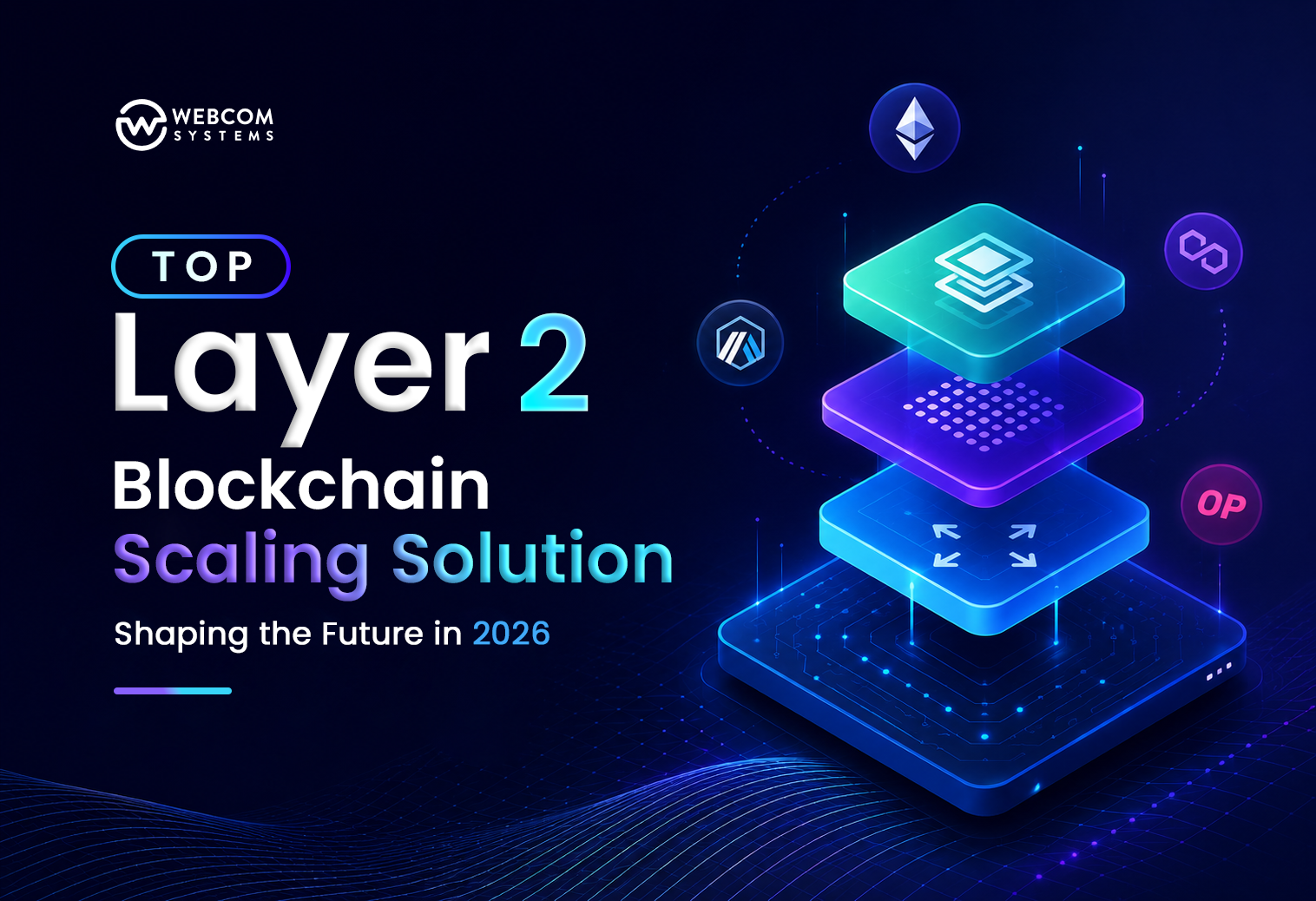
Top Layer 2 Blockchain Scaling Solutions Shaping the Future in 2026
Category : Blockchain / by Andrew
Over the past few years, blockchain has made its place as part of operational infrastructure across industries, delivering innovations like decentralised finance (DeFi), real estate tokenisation, on-chain gaming, and more.
Indeed, blockchain innovation brought about major breakthroughs with its promising decentralisation and openness, but its networks often struggled to deliver speed at scale. It has repeatedly encountered congestion, unpredictable fees, and other scalability limitations that made institutional adoption feel perpetually one upgrade away.
Also Read: Crypto Startup Launch Plan 2026: Marketing & Exchange Listing
But, Every time blockchain technology is put in boxes, it has managed to push boundaries and redefine what it can make happen, and scalability is no exception. In 2026, the narrative has changed from whether blockchain can scale to how scaling should happen.
Many Layer 2 ecosystems have already been powering operating systems of decentralised finance, gaming, identity, and tokenised real-world assets. Read this list to know the top Layer 2 blockchain scaling solutions shaping the future in 2026 and why they matter.
What Are Layer 2 Blockchain Scaling Solutions?
Before moving on to the list, a general question comes to mind: what are layer 2 blockchain solutions really?
Basically, Layer 2 blockchain scaling solutions define the protocols that are built on top of Layer 1 decentralised networks. Most commonly, they are developed on Ethereum to increase transaction speed and reduce network costs. However, the goal is to improve both while preserving and relying on the base layer’s security and decentralisation features.
Now, how this happens is. Ethereum maintains the trust, security, and decentralization of the network, but Layer 2 solutions handle most transaction processing. Instead of executing every transaction on the main chain, Layer 2 networks process transactions off-chain and then submit the final results back to Ethereum for settlement. This approach significantly increases transaction speed, reduces network congestion, and lowers costs. As a result, Ethereum can support growing demand more efficiently while Layer 2 networks provide faster and more scalable execution environments for decentralized applications.
Besides, these Layer 2 solutions can be easily integrated with the current blockchain infrastructure, in contrast to carrying out extensive Layer 1 upgrades.
Types of Layer 2 Scaling Solutions
All Layer 2 ecosystems seek to improve scalability, but they don’t act in the same way. These architectures have to prioritise different trade-offs between speed, decentralisation, security, and efficiency.
- Optimistic Rollups: They consider all the transactions to be valid unless challenged. Their strong compatibility with Ethereum has made them one of the most widely used scaling solutions.
- Zero-Knowledge (ZK) Rollups: Zero-Knowledge (ZK) rollups use cryptographic proofs to verify transactions prior to settlement. This model frequently produces higher efficiency and faster finality.
- Validiums and State Channels: These approaches help to move more activity off-chain, increasing throughput. That’s why both validiums and state Channels are used in high-power applications like gaming, digital asset payments, and high-frequency interactions.
Best Layer 2 Blockchain Solutions of 2026
Here is the list of the top Layer 2 blockchain solutions that are redefining the future of blockchain app development in 2026:
Arbitrum
Among Layer 2 ecosystems, Arbitrum holds a dominant position in 2026, largely because it perfectly balances reliability, ecosystem maturity, and developer familiarity. All three are rarely present in any other layer 2 network to date. It uses optimistic rollup technology to process transactions off-chain before settling them on Ethereum. This reduces gas fees (up to 90%) and speeds up transactions.
Developers prefer Arbitrum due to its compatibility with Ethereum smart contracts, as well as strong documentation, mature developer tooling, and great ecosystem incentives. From decentralised exchanges to derivatives markets and enterprise-oriented financial tooling, Arbitrum is a popular execution environment for high-value decentralised activity.
kSync
Built by Matter Labs, zkSync is the strongest example of zero-knowledge technology moving from pilot projects to practical infrastructures. Before zkSync, Zero-knowledge rollups were indeed treated as intellectually groundbreaking for years but too intricate to implement for scaling blockchain networks.
zk-rollups mathematically prove transaction validity through cryptographic evidence before settlement and post validity proofs back to ETH. This model combines cryptographic sophistication with usability and delivers robust security assumptions, faster finality, and greater scalability potential.
Optimism
If Arbitrum represents stability, Optimism represents architectural ambition. It is bringing Superchain, an interconnected network of Layer 2 chains, which would solve the fragmentation issues by allowing multiple chains to behave less like isolated platforms and more like a single digital economy. Optimism’s OP Stack has emerged as a leading blockchain development framework, powering major ecosystems like Coinbase’s Base network and a number of enterprise-grade deployments.
Starknet
Starknet is one of zkSync’s strongest competitors. While zkSync is widely recognized for its accessibility, Starknet stands out for its technical rigor and exceptional computational performance. Built on STARK proofs, this quantum-resistant network enhances scalability for enterprise-grade decentralized applications, including blockchain gaming, AI-driven coordination systems, and complex financial platforms. Its advanced architecture enables developers to process large volumes of transactions efficiently while maintaining strong security and decentralization.
Working on this network needs excellence in its custom programming language, Cairo, which initially slowed adoption. But now it is powering Ekubo, Endur, and many other resource-intensive apps in the market, which can cost a lot if run solely on layer 1 blockchains.
Base
Base is Coinbase’s powerful layer-2 project that made its mark on the industry with distribution. It is built on the OP Stack and employs optimistic rollups to deliver high-speed, low-cost transactions and maintain Ethereum security. Base’s true strength lies less in technical novelty and more in accessibility. Most crypto-native communities often prefer technical sophistication, but its developer-friendliness is increasing mainstream adoption across decentralised finance (DeFi), creator economies, and on-chain consumer applications.
Polygon
It is impossible to complete the list without mentioning Ethereum’s affordable sidechain solution, Polygon. It operates as a proof-of-stake (PoS) sidechain parallel to ETH to process transactions much faster and more cheaply. But instead of working just as a single scaling network, it acts as a complete ecosystem that features zero-knowledge technologies, modular scaling frameworks, enterprise blockchain integrations, and institutional tokenisation efforts.
Although Polygon doesn’t inherit the security of the Ethereum network, due to its unusual resilience, it has still positioned itself as the leading choice for enterprise adoption and decentralised infrastructure.
End Note
With Layer 2, large-scale blockchain adoption has become possible. In 2026, Layer 2 solutions are helping address long-standing limitations around speed, transaction costs, and interoperability. They are engineering a much more practical foundation for decentralised applications and enterprise adoption.
At Webcom Systems, we specialise in delivering custom blockchain development to power modern decentralised ecosystems, from Layer 2 integrations and smart contract development to DeFi platforms, tokenisation, and enterprise-grade Web3 applications.
The future of blockchain is unfolding now, and as a trusted Blockchain Development Company in Australia, we help industries build scalable, secure, and future-ready Web3 applications.
Whether you are launching a blockchain product or modernising existing infrastructure, our professionals can help your enterprise turn ideations into production-ready solutions. Get in touch today.
Also Read: How to Choose a CRM for Your Forex Brokerage
Related Posts
Webcom Systems Pty Ltd is a technology development and consulting company that builds blockchain, Web3, digital currency, NFT, DeFi, remittance, and related software solutions. Our role is strictly limited to providing software development, technical architecture, and strategic consulting services. We do not provide financial, investment, brokerage, exchange, asset management, taxation, legal, or trading services to businesses or individuals. We do not operate financial institutions, manage client funds, execute trading operations on behalf of users, or offer investment, tax, or legal advice of any kind.
Any legal compliance, license, regulatory approval, government registration, permit, KYC/AML implementation, and any other statutory obligation must be obtained and managed entirely by the client. Webcom Systems Pty Ltd does not assist in obtaining licenses or regulatory approvals from any authority.
All information provided on our website, marketing materials, proposals, and communications is for general informational purposes and does not contain investment, legal, or financial advice specific to you. You may rely on this information strictly at your own risk. No particular piece of information issued by us constitutes a proposal or request for a proposal to invest. We do not recommend, endorse, or sponsor any assets, securities, companies, or funds.
Clients are entirely responsible for conducting independent due diligence and are professionally advised to seek assistance from licensed financial advisors, legal counsel, and regulatory professionals to make such critical choices. Webcom Systems Pty Ltd accepts no liability for any decisions or financial consequences of your investment decisions.
Risk WarningInvesting and trading in financial markets involve a high level of risk. The value of financial products may fluctuate significantly, and you may lose part or all of your invested capital. It is preferable to fully comprehend how different financial products work before making any investment decisions. You should also carefully evaluate your financial situation, investment goals, and risk tolerance, and consider all risks involved before investing.
Error: Contact form not found.