

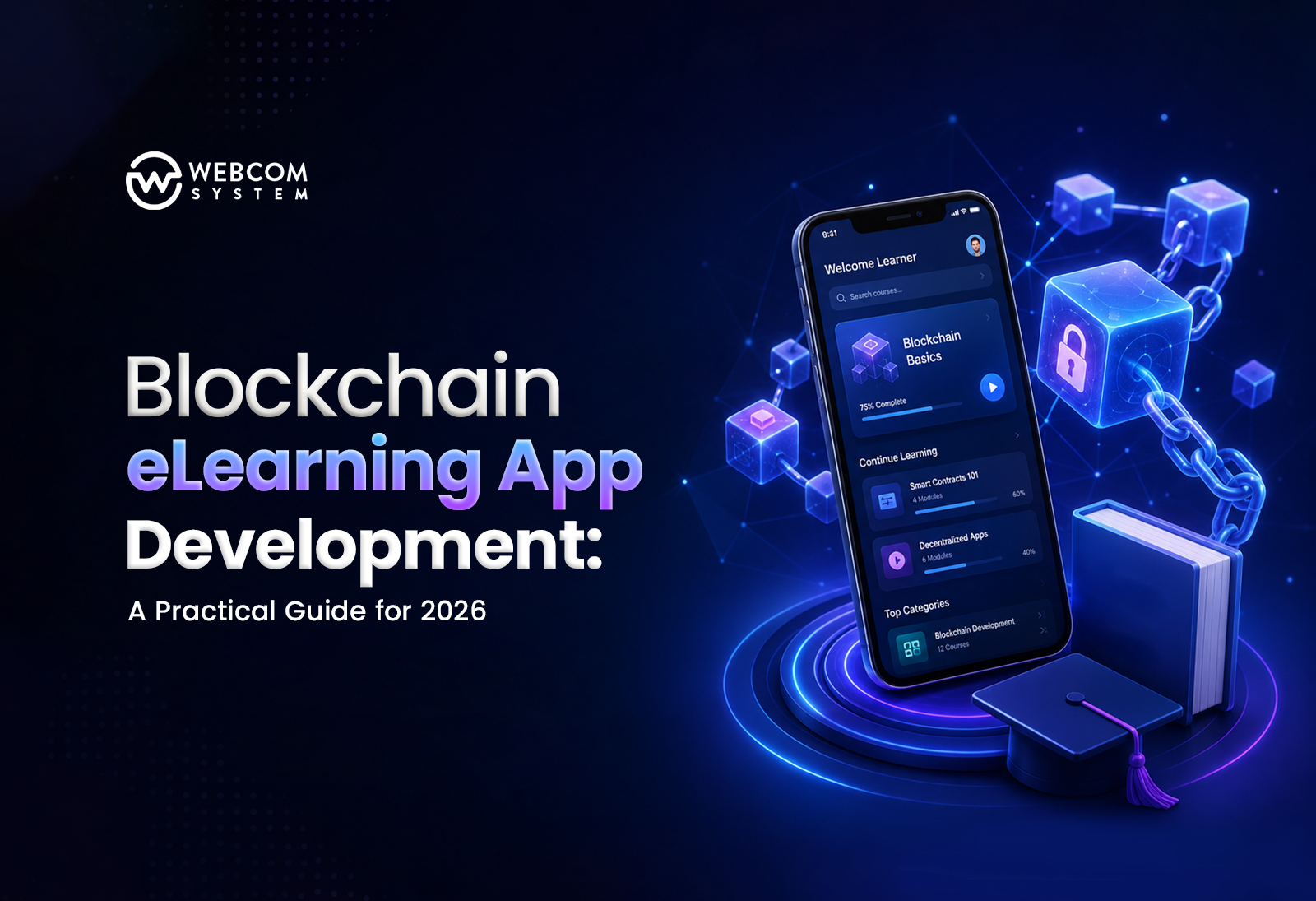
Blockchain eLearning App Development: A Practical Guide for 2026
Category : Blockchain / by Andrew
In the last decade, the education industry has entirely changed, moving learning from conventional classroom settings to mobile devices and tablets. Nowadays, eLearning platforms have made quality education available to almost anyone, anywhere in the world. And it’s not just about convenience anymore; digital experiences have made learning more insightful and engaging for students.
Nevertheless, the e-learning ecosystem still struggles with some lingering challenges over documentation fraud, learner identity verification, credential authenticity, data ownership, and much more. These loopholes pushed tech enthusiasts to explore more secure and transparent technologies, where blockchain technology delivers excellent results.
In 2026, many educational institutions, EdTech startups, corporate training providers, and certification platforms will be integrating blockchain into learning ecosystems. Blockchain app development has helped these institutions in upgrading the educational environment by solving persistent problems using its decentralised, tamper-resistant, and transparent architecture.
Also Read: Why Is Blockchain Essential for Fantasy Sports App Development?
In this guide, we will explore blockchain eLearning app development in detail, including its benefits, features, development process, use cases, and much more.
What is a Blockchain eLearning App Development?
So, basically, Blockchain eLearning App development involves the process of building decentralised learning platforms by using blockchain technology. These digital educational platforms help to securely store, verify, and manage educational data.
Now, as basic web apps feature centralised databases, these decentralised eLearning Apps use immutable digital ledgers to securely record information that cannot be altered or deleted without authorisation. Now, what this means is that all the important educational data, such as certificates, student records, learning achievements, and more, can be managed in a transparent and secure educational environment.
Why Blockchain Development is Important in eLearning
As we discussed, indeed, the eLearning platforms have improved the traditional educational industry. However, taking such critical data online on digital platforms has introduced trust-related problems. These digital platforms are extremely vulnerable to data breaches, fake certificates, unauthorised modifications, and inefficient verification processes.
But employing blockchain as infrastructure can fix these problems through its core distributed ledger framework and deliver decentralisation, immutable record-keeping, smart contract automation, secure identity verification, and transparent credential management.
Let’s go over these benefits of Blockchain eLearning App Development in detail:
Tamper-Proof Certifications
The prime benefit of blockchain is building the authenticity of credential documents. By bringing academic certificates and training records on a chain, they can’t be manipulated or forged. Hence, institutions and employers can instantly verify educational qualifications without having to worry about fake degrees.
Decentralized Ownership
Not just the educational institutions, but learners greatly benefit from blockchain’s decentralised model. They can independently manage their credentials using digital wallets or decentralised identities. Moreover, they can confidently prove the authenticity of their credentials to universities, recruiters, or employers without fear of third-party manipulation.
Improved Data Security
Educational institutions handle a great deal of sensitive student information. This data, when managed on centralised databases, often becomes vulnerable to cyberattacks and data leaks. However, blockchain encryption and distributed record-keeping across decentralised networks eliminate these security risks once and for all.
Faster Verification Processes
It is obvious that manual record verification is time-consuming. Additionally, there is always the possibility of human error as well. Blockchain solutions help in carrying out instant verification through publicly accessible ledger records. This hastens the document review process during international admissions, remote hiring, and more for educational institutions and companies.
Global Accessibility to Certified Education
Blockchain technology creates a secure database of both learning content and certifications. It can be accessed by all the verified parties without any geographical restrictions. Hence, institutions can easily reach international audiences, and learners worldwide can access trusted education.
Better Transparency
Blockchain helps to improve transparency in grading systems, certifications, attendance tracking, and course completion records. This simply eliminates any potential disputes over grades or achievements.
Smart Contract Automation
Smart contracts automate a variety of educational processes, including course enrolment, certificate issuance, teacher payments, scholarship disbursement, and more. This directly reduces work pressure for carrying out all these procedures manually.
Step-By-Step Blockchain eLearning App Development Process
Blockchain Development is not as simple as web app development. Building a decentralised eLearning app requires a structured development approach as well as high-grade tools and technologies.
The basic step-by-step process for powerful blockchain-based eLearning apps goes as follows:
Requirement Gathering
The first and foremost step of this app development is to actually first analyse and identify what core issues need to be addressed using blockchain. Is it Credential fraud, Student ownership, Interoperability, or anything else?
Afterwards, it is evaluated whether blockchain can actually address these issues. If so, the project actually proceeds further.
Select the Blockchain Architecture
Once all the issues are spotted and employing blockchain makes sense in each scenario, the next question is how it can be implemented.
Blockchain operates on various models, including public, permissioned, and hybrid architectures. As per the exact requirements of the project, especially regarding privacy and security, an ideal architecture is finalised for blockchain eLearning app development.
Sorting Out Core Features of the eLearning App
After selecting the blockchain model, the design team selects core features of the eLearning App. Some of the essential functionalities of these apps typically include user registration and authentication, smart contract integration, secure payment gateways, credential issuance and verification, course management systems, progress tracking, and more. In addition to these, advanced features are chosen based on the needs of the project.
Designing App Interface
Now, the app design team works on creating a user-friendly and intuitive interface for the blockchain eLearning app. The interface is specifically designed for mobile devices, tablets, and desktop computers to deliver a smooth learning experience across all platforms.
Although the technologies that power the app are complex, the app is designed to be simple to use and navigate for both learners and educators.
Smart Contract Development
Moving on to development, blockchain developers create smart contracts using high-grade coding practices for automating tasks such as certificate issuance, verification, rewards, payments, and more.
Moreover, these contracts are tested using both manual and automated auditing tools to identify vulnerabilities early on and optimise them in a timely manner.
Build the App Learning Infrastructure
Once the blockchain foundation and smart contracts are ready, the development team starts building the complete learning infrastructure of the application. They will develop core modules like video streaming systems, LMS functionality, quizzes and assessments, live class integrations, and more.
In addition, they integrate APIs and backend services to make sure that blockchain networks and application interfaces communicate smoothly.
Ensure Compliance and Privacy
While providing transparency and implementing decentralised storage, it is equally important for the app to comply with regulations such as GDPR, FERPA, and other regional laws applicable to digital learning platforms.
That’s why the development team confirms that secure data handling, encryption, user consent, and access controls are used in the app to secure sensitive student information and maintain compliance.
Testing And Launch
At this point, the eLearning app is tested using various testing procedures such as functional testing, performance testing, and much more. Every spotted bug and vulnerability is removed immediately to finally launch the app on relevant app stores and web platforms.
Post-Launch Support
After the eLearning app launch, a dedicated team analyses the app 24*7 to provide necessary optimisations and upgrades to keep it secure, efficient, and up-to-date.
Key Use Cases of Blockchain Development in eLearning
Blockchain in education is already creating major ripples and shaping the future of learning ecosystems. Here are some of the use cases of blockchain in eLearning as explained below:
- Blockchain-Based Certificates and Diplomas
This is the most popular use case, but it creates a major difference as well. Educational institutions issue blockchain-backed certificates containing cryptographic proofs. The use of verifiable credentials has grown since the W3C Verifiable Credentials Data Model 2.0 gained official recommendation in 2025.
- Micro-Credentials and Skill Badges
Aside from traditional degrees, blockchain helps in creating micro-credentials and badges from bootcamps, online academies, corporate training, vendor certifications, and more.
- Decentralised Learning Records
Nowadays, students pick multiple eLearning platforms to improve their skills, knowledge, and career prospects. Blockchain helps these students by creating permanent learner records to store their achievements from different systems under a single identity.
- Tokenised Learning Ecosystems
Tokenisation is the process of representing and managing a physical or financial asset on a blockchain and converting it into a digital asset. Many learning platforms are creating certification tokens for course completion, community participation, and more. Token holders can use their tokens to get course credits, premium features, or any other assigned utility.
Final Thoughts
Blockchain eLearning app development has completely changed the way educational systems operate in 2026. Blockchain infrastructure plays a critical role in solving the macro issues by building more secure and trustworthy digital learning environments.
Many blockchain development companies in Australia provide decentralised eLearning application development support, but only a few of them have the tech expertise to deliver future-ready eLearning solutions.
At Webcom Systems, we help educational institutions and corporate training providers incorporate blockchain into their eLearning platforms. We offer end-to-end blockchain eLearning app development services, helping in ideation, architectural design, core development, app launch, and everything in between. Every eLearning platform we deliver is specifically engineered, fitting all the latest features to meet the project’s needs and compliance requirements.
Looking to build your own decentralised eLearning app? Get in touch with Webcom Systems today.
Also Read: What Industries Benefit Most From RWA Tokenization Development?
Related Posts
Webcom Systems Pty Ltd is a technology development and consulting company that builds blockchain, Web3, digital currency, NFT, DeFi, remittance, and related software solutions. Our role is strictly limited to providing software development, technical architecture, and strategic consulting services. We do not provide financial, investment, brokerage, exchange, asset management, taxation, legal, or trading services to businesses or individuals. We do not operate financial institutions, manage client funds, execute trading operations on behalf of users, or offer investment, tax, or legal advice of any kind.
Any legal compliance, license, regulatory approval, government registration, permit, KYC/AML implementation, and any other statutory obligation must be obtained and managed entirely by the client. Webcom Systems Pty Ltd does not assist in obtaining licenses or regulatory approvals from any authority.
All information provided on our website, marketing materials, proposals, and communications is for general informational purposes and does not contain investment, legal, or financial advice specific to you. You may rely on this information strictly at your own risk. No particular piece of information issued by us constitutes a proposal or request for a proposal to invest. We do not recommend, endorse, or sponsor any assets, securities, companies, or funds.
Clients are entirely responsible for conducting independent due diligence and are professionally advised to seek assistance from licensed financial advisors, legal counsel, and regulatory professionals to make such critical choices. Webcom Systems Pty Ltd accepts no liability for any decisions or financial consequences of your investment decisions.
Risk WarningInvesting and trading in financial markets involve a high level of risk. The value of financial products may fluctuate significantly, and you may lose part or all of your invested capital. It is preferable to fully comprehend how different financial products work before making any investment decisions. You should also carefully evaluate your financial situation, investment goals, and risk tolerance, and consider all risks involved before investing.
Error: Contact form not found.