

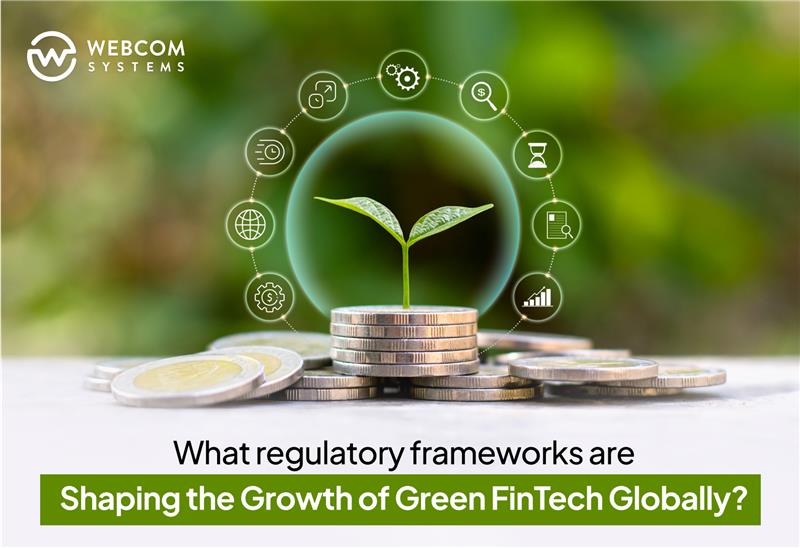
Financial technology (FinTech) played a big role in transforming financial services by integrating advanced technologies and altering the way transactions are conducted. Recently, the fintech sector has begun to combine finance with sustainability and presented a whole new concept of Green FinTech.
Many fintech development companies are encouraging green initiatives by developing Green Fintech solutions. It is even projected that the green fintech market will experience a compound annual growth rate (CAGR) of an impressive 22.4% globally between 2024 and 2029.
Most importantly, the Green Fintech approach has pushed global authorities to reframe the regulatory frameworks to align financial services with climate goals. Let’s explore these regulations and their role in shaping global fintech adoption in more detail. But let’s understand a little more about fintech.
Also Read: How Blockchain Is Revolutionizing the Fintech Industry?
Understanding Green FinTech
Green FinTech refers to the use of financial technology to promote environmental protection and achieve sustainability goals. Banks, investment firms, and financial service providers are increasingly choosing FinTech solutions over traditional options to sustain ecological goals.
Green FinTech has numerous applications, some of which are as follows:
- Green Bond Platforms: These innovative platforms manage financial instruments such as green bonds and loans to fund various environmental projects.
- ESG Investing Platforms: Environmental, Social, and Governance digital solutions employ AI algorithms to manage risk and automate adherence to ESG regulations. They even provide scoring for companies based on their metrics for environmental responsibility.
- Carbon Credit Trading Platforms: These fintech solutions are employed for the issuance, tracking, and management of carbon credits.
- Climate Risk Assessment Tools: These advanced tools not only monitor the platforms to assess financial risks associated with climate change but also mitigate them.
- Blockchain-based Platforms: The decentralised ledger of blockchain technology can be used to monitor environmental practices. Blockchain development solutions that offer full transparency enable companies to show their commitment to environmental responsibility.
Key Role of Regulatory Frameworks In Green FinTech
Green FinTech is altering the finance industry, all for good reasons. But, as a technology emerges and advances to provide various applications for businesses, it calls for some regulations to ensure legal and secure practices. Without such regulations, both intentional and unintentional harm can occur. This need for oversight has led to the creation of regulatory frameworks that support compliant development in FinTech.
Here are some of the important roles that Green FinTech plays in bringing innovations to the sector every day:
- Regulations provide a structured approach for Green Fintech adoption and alleviate confusion around this concept for new investors and financial institutions.
- With such obligations, financial institutions become more accountable to limit the environmental impacts and maintain the sustainability metrics.
- By opting for Green Fintech and even maintaining regulatory compliance, fintech companies can build trust among their customers and investors as well.
- It becomes easier for companies to mitigate the risks associated with unsustainable financial practices, such as potential greenwashing.
Global Standards and Frameworks Shaping the Growth Of Green FinTech
The majority of countries where fintech giants operate, including Europe, the United States, and Australia, have established some of the frameworks to regulate the development of fintech solutions. Some of these frameworks are as follows in these countries:
European Union (EU)
The European Union (EU), which consists of the union of 27 European member states, has taken a strong initiative to incorporate sustainability into its financial regulations. The EU Taxonomy Regulation provides a complete list of environmentally sustainable activities that support Green initiatives. Additionally, the Sustainable Finance Disclosure Regulation (SFDR) requires fintech companies to share their sustainability criteria in their fintech solutions.
European-based financial firms must follow these regulations to engage in sustainable practices and provide complete transparency regarding their sustainability claims to the authorities.
Australia
In Australia, all the financial institutions involved in fintech are overseen by various regulatory bodies. Although these regulations are still in the early stages of development. The Australian Securities and Investments Commission (ASIC) is actively working to improve its ESG disclosure requirements to better align with fintech practices. Likewise, the Australian Prudential Regulation Authority (APRA) offers guidance to banks, insurers, and financial institutions on their green fintech initiatives.
United States
Regulatory procedures for Green FinTech solutions have evolved in the United States over the past couple of years. Although there are no specific frameworks in place so far, government organisations such as the Securities and Exchange Commission (SEC) require firms, both established and startups, to provide climate-related disclosures. However, most states are also working on their own regulations to provide regulatory structures to follow in order to promote green investments and sustainable practices.
Common Challenges In Adopting Green FinTech Regulations
Indeed, regulatory frameworks have facilitated the adoption of sustainability by fintech firms. However, these regulatory frameworks create challenges as follows:
- Fintech businesses that operate globally find it difficult to comply with the regulations of multiple jurisdictions. Further, it is even more difficult to deliver green financial services in the areas that still haven’t provided clarity on their regulations.
- Despite there being some efforts, there is still massive confusion and uncertainty across jurisdictions around what they actually mean by the ‘green’ fintech. The term remains confusing in their frameworks.
- Of course, there are climate-related financial risks, but still, there is no firm and sufficient data on environmental impacts and sustainability metrics. As a result, risk assessment and decision-making become increasingly complex.
- There has been quite a bit of progress by different nations in simplifying the regulated green fintech adoption. Yet existing regulations are quite unclear themselves, which makes the compliance even more complicated.
Wrapping Up
From green decentralized finance to carbon tracking and much more, the Green FinTech solutions are making sustainable finance actually possible. As the Green FinTech sector is expanding, authorities are improving regulatory frameworks. Although there are some gaps, firms can expect greater clarity on these regulations to ensure compliance and deliver transparency in their sustainable approaches.
Are you looking to incorporate sustainability in your financial services as well?
Webcom Systems can assist you with that. We are a leading Fintech Software Development company in Australia that specializes in building Green Fintech solutions for financial firms of all sizes and business models. We offer initial consulting support to guide you through the implementation of Green FinTech solutions, as well as development and launch assistance. Moreover, our research and development team stays updated on the latest protocols to deliver sustainable fintech solutions in compliance with regulatory frameworks. Contact us now to discuss your project.
Also Read: Fintech Integration Challenges And Our Proven Solutions
Related Posts

Webcom Systems Pty Ltd is a technology development and consulting company that builds blockchain, Web3, digital currency, NFT, DeFi, remittance, and related software solutions. Our role is strictly limited to providing software development, technical architecture, and strategic consulting services. We do not provide financial, investment, brokerage, exchange, asset management, taxation, legal, or trading services to businesses or individuals. We do not operate financial institutions, manage client funds, execute trading operations on behalf of users, or offer investment, tax, or legal advice of any kind.
Any legal compliance, license, regulatory approval, government registration, permit, KYC/AML implementation, and any other statutory obligation must be obtained and managed entirely by the client. Webcom Systems Pty Ltd does not assist in obtaining licenses or regulatory approvals from any authority.
All information provided on our website, marketing materials, proposals, and communications is for general informational purposes and does not contain investment, legal, or financial advice specific to you. You may rely on this information strictly at your own risk. No particular piece of information issued by us constitutes a proposal or request for a proposal to invest. We do not recommend, endorse, or sponsor any assets, securities, companies, or funds.
Clients are entirely responsible for conducting independent due diligence and are professionally advised to seek assistance from licensed financial advisors, legal counsel, and regulatory professionals to make such critical choices. Webcom Systems Pty Ltd accepts no liability for any decisions or financial consequences of your investment decisions.
Risk WarningInvesting and trading in financial markets involve a high level of risk. The value of financial products may fluctuate significantly, and you may lose part or all of your invested capital. It is preferable to fully comprehend how different financial products work before making any investment decisions. You should also carefully evaluate your financial situation, investment goals, and risk tolerance, and consider all risks involved before investing.
Error: Contact form not found.