

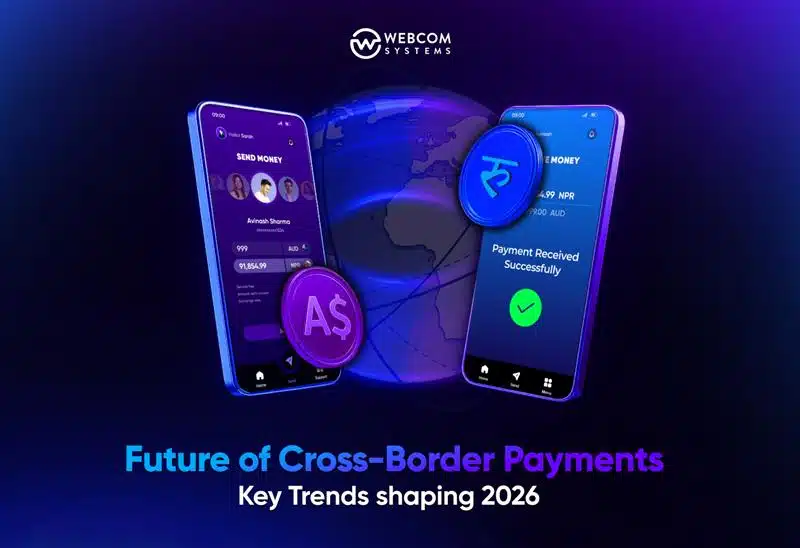
Future of Cross-Border Payments: Key Trends Shaping 2026
Category : Cross-Border Payment / by Andrew
The cross-border payments sector is evolving with each passing year and fundamentally changing the way money moves across borders. This shift is evident not only in day-to-day transactions but also in the underlying market data.
In 2024, the international payments market reached an impressive USD 347.7 billion, due to technological innovation, regulatory clarity, and, obviously, the growing adoption of digital infrastructure worldwide. Results? Higher volumes of international trade, digital commerce, and global financial interactions than ever before.
But what’s even more remarkable is that the global cross-border payments market is projected to grow to USD 620.15 billion by 2032. Over the next few years, financial institutions, fintechs, and central banks will continue to modernise their payment networks, operational frameworks, and cross-border payment software. Hence, the world will become more interconnected, and international money transfers will not be that different from local payments in terms of speed as well as ease.
Also Read: Money Remittance Software for Cross-Border Payment in Australia
Not only that, but we don’t even need to wait for the far future. By 2026, the landscape will look very different from today. Let’s explore how?
Understanding Cross-Border Payments
Instead of directly heading into the future of cross-border payments, let’s first understand the basics of these financial transactions, like how these payments actually work and the role they play for the countries worldwide.
What are Cross-Border Payments?
A cross-border payment is a type of financial transaction where funds are moved from the sender located in one country to the recipient in another. The process involves moving money through international payment networks and converting it from one currency to another (in most cases). These transactions are often referred to as international payments, remittances, or global money transfers.
Different Cross-Border Payment Types
Individuals, businesses, banks, financial institutions, governments, or other entities may participate in a cross-border payment to actually make it possible. However, these payments are classified primarily based on the nature of the sender and recipient parties, as follows:
- B2B (Business-to-Business): Refers to cross-border payments made between two businesses in different countries.
- B2C (Business-to-Consumer): Cross-border payments made by a business to individual consumers in another country.
- C2B (Consumer-to-Business): International payments sent by an individual to an enterprise in another country.
- C2C (Consumer-to-Consumer): Money remittance payments made between two individuals in different countries.
How Do International Payments Operate?
No matter the type of international payment, it can actually be carried out through multiple payment methods. While there are many traditional options, such as bank transfers, wire transfers, and more, modern digital channels include:
- Credit and Debit Card Transactions: International payments are carried out using credit and debit cards, for example, Visa, Mastercard, or Amex.
- Bank Payments: It employs banking networks such as SWIFT or correspondent banking to process cross-border payments.
- Mobile Payments and Digital Wallets: It involves the use of cross-border payment software, digital wallets, and fintech platforms.
Key Roles Of Cross-border Payments
Cross-border payments are used to transfer funds for both personal and professional purposes. Here are some of the purposes and roles that cross-border payments serve:
- Migrants make international payments to send money to their loved ones in their home country.
- Individuals and organisations use cross-border money transfers for donations to international charities and nonprofit organisations.
- Global money transfers facilitate international trade. They are used by businesses to pay for goods and services from companies in other countries. These Business-to-business (B2B) transactions make up around 97% of total cross-border payments.
- International money transfers help individuals to purchase goods or sign up for services from international businesses.
- Cross-border payments allow travellers to pay for services like hotels, flights, and more or purchase products while travelling.
- Cross-border financial transactions allow investors to capitalise on international businesses or valuable assets, such as stocks, real estate, etc., in other countries.
Major Trends Shaping Cross-Border Payments In 2026
The increase in global trade and individuals demanding secure and fast remittances pushed the industry to innovate.
Currently, cross-border payment software that allows digital payments to process international payments is transforming the cross-border payments market. Moreover, even the government authorities are supporting digital international payments by defining the guidelines to process these transactions legally and securely.
The industry is already doing extremely well, but there will be plenty to see in 2026. The following trends will transform the landscape of cross-border payments:
Implications Of Post-ISO 20022
The modernisation of payment messaging formats is already underway across the financial sector. However, by 2026, most major payment systems will have fully switched to the ISO 20022 payment messaging standard. As a result, the most common format for business messages would be consistent and structured.
This transition from legacy messaging frameworks will improve compliance, reconciliation, speed, automation, and security in international payments. Here’s how:
- A data-rich environment will equip AI systems to make more context-aware decisions and hence increase accuracy.
- Cross-border transactions will carry complete and structured information. It gives remitters clear visibility into transaction status, processing steps, and cost structures.
- The use of structured and standardised data will improve the speed and reliability of compliance checks. Hence, they strengthen fraud prevention and AML capabilities.
- Due to automated reconciliation processes, companies will save a lot of time that is typically lost to resolving payment-to-invoice errors. Not to forget, it will improve the business reputation as well.
Real-Time and Instant Payment Settlement Systems
Legacy banking systems involve the use of credit cards, debit cards, and related means to settle international payments. These payments are secure and reliable, but take a long time due to the numerous correspondent bank intermediaries involved in completing the payments.
Modern remittance platforms would employ domestic instant payment modes such as Australia’s New Payments Platform (NPP), India’s UPI, Singapore’s FAST, and Europe’s SEPA Instant to process payments instantly. It may involve the use of the “one-leg-out” model, which means that the cross-border payment can be initiated or completed using a domestic real-time payment rail. This real-time processing of cross-border payments will have the following impact:
- Businesses can settle even the high-cost payments in seconds. It leads to business growth and hence improves global trade.
- Shorter international payment chains would eliminate intermediaries and simplify payment networks.
- The simplified remittance even lowers intermediary fees and increases the value of transfers, which is especially useful for low-value money transfers.
- Shorter payment chains also improve visibility and transparency in payment processing.
Generative AI in Payment Operations
Generative AI is making its way to each and every sector, from healthcare to finance to logistics to retail; basically, anything you can think of. But the way it will assist the international payments is just incredible.
Generative AI can automate the routine tasks for remittance businesses, including reconciling transactions, addressing customer concerns, and compliance checks.
Not just this, the personalisation offered by AI technology in the remittance application will improve the remittance experience for the users.
B2B cross-border payments, which often involve high-value transactions, are vulnerable to cyberattacks and fraud. Gen AI helps with this by monitoring transactions and flagging anomalous transactions in real time for timely fraud detection and prevention.
Growth of Stablecoins and Tokenised Assets
Stablecoins offer the best of both worlds. They utilise smart contract automation, eliminating the need for intermediaries and also benefiting from the decentralisation of blockchain technology, just like cryptocurrencies. But, unlike Bitcoin, Stablecoins are highly stable, as they are pegged to the value of a traditional currency.
In 2026, stablecoins and tokenised money are expected to see broader adoption in cross-border payment flows. The reason behind the wider adoption in the future is mainly due to the better clarity on the regulatory frameworks governing how stablecoins must be issued, backed, and supervised by the government authorities worldwide. This would help as follows:
- Regulations around reserves, audits, and licensing will increase trust and legitimacy of stablecoins.
- Without worrying about noncompliance, financial giants and banks would freely explore tokenised deposit models to benefit from blockchain technology.
- As the tokenised assets can settle instantly on distributed ledgers. The removal of multiple intermediaries would lead to faster and much cheaper cross-border payments.
- The decrease in reliance on credit card payments, which are the most prevalent fraud target in the world economy.
Enhanced Customer Experience with Digital Wallets
Global cross-border payment platforms make it possible to make contactless online payments with mobile wallets. By 2026, it is expected that more businesses, as well as individuals, will use mobile wallet transactions to pay foreign merchants and service providers.
Credit card payments have a processing fee ranging from 1.15% to 3.15% per transaction. Mobile wallets, on the other hand, allow payments to be processed with much lower transaction fees and that too in much less time.
Hence, beneficiaries living across borders would thus be able to access funds in a timely, simple, and convenient manner.
Wrapping Up
In the coming months, important technologies like tokenised assets, stablecoins, instant-payment networks, ISO 20022 messaging, Gen AI, and more will significantly change cross-border payments.
If you are an enterprise also looking to incorporate these emerging technologies and be a part of innovation transforming the future of cross-border payments, Webcom Systems can assist you with this. We are Australia’s leading FinTech Software Development Company that equips businesses like yours to innovate their operational models with our high-tech money transfer software solutions.
We have an in-house research and development team that works day and night to explore and test the implementation of emerging innovations into the financial systems of enterprises of different operational models. Not just this, we have the top-tier industry specialists, fintech developers, solution architects, UI/UX designers, and QA engineers building robust platforms that offer instant, secure international payments.
Interested in knowing more about our services? Get in touch today.
Also Read: Mobile Remittance Apps: Revolutionising Payments for Australians
Related Posts
Webcom Systems Pty Ltd is a technology development and consulting company that builds blockchain, Web3, digital currency, NFT, DeFi, remittance, and related software solutions. Our role is strictly limited to providing software development, technical architecture, and strategic consulting services. We do not provide financial, investment, brokerage, exchange, asset management, taxation, legal, or trading services to businesses or individuals. We do not operate financial institutions, manage client funds, execute trading operations on behalf of users, or offer investment, tax, or legal advice of any kind.
Any legal compliance, license, regulatory approval, government registration, permit, KYC/AML implementation, and any other statutory obligation must be obtained and managed entirely by the client. Webcom Systems Pty Ltd does not assist in obtaining licenses or regulatory approvals from any authority.
All information provided on our website, marketing materials, proposals, and communications is for general informational purposes and does not contain investment, legal, or financial advice specific to you. You may rely on this information strictly at your own risk. No particular piece of information issued by us constitutes a proposal or request for a proposal to invest. We do not recommend, endorse, or sponsor any assets, securities, companies, or funds.
Clients are entirely responsible for conducting independent due diligence and are professionally advised to seek assistance from licensed financial advisors, legal counsel, and regulatory professionals to make such critical choices. Webcom Systems Pty Ltd accepts no liability for any decisions or financial consequences of your investment decisions.
Risk WarningInvesting and trading in financial markets involve a high level of risk. The value of financial products may fluctuate significantly, and you may lose part or all of your invested capital. It is preferable to fully comprehend how different financial products work before making any investment decisions. You should also carefully evaluate your financial situation, investment goals, and risk tolerance, and consider all risks involved before investing.
Error: Contact form not found.