

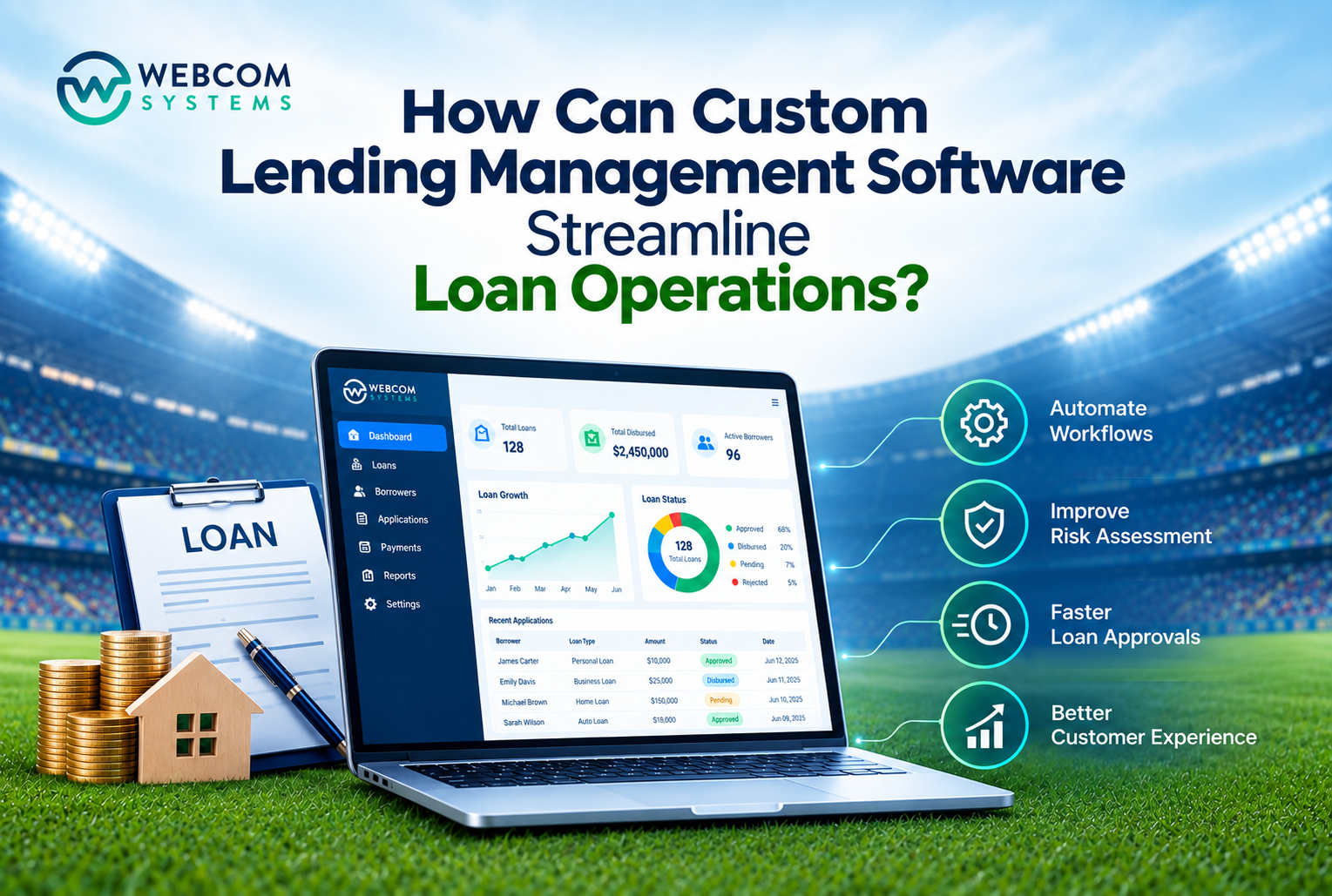
How Can Custom Lending Management Software Streamline Loan Operations?
Category : Loan Management / by Andrew
While traditional banks ruled the loan market for years, alternative lenders and other financial institutions have become increasingly common in 2026. Lending businesses have carved out their space by offering more flexible financing options and meeting the diverse needs of individuals and businesses.
However, handling loan volumes, borrower information, documentation, approvals, repayments, and compliance requirements through legacy approaches can be challenging for lending businesses. This is where custom lending management software becomes extremely helpful. These personalised lending software solutions reduce operational hassle for lenders, improving efficiency and enhancing the borrowing experience.
In this blog, we explore how custom lending management software can streamline loan operations and why it can be a valuable technology investment for modern lenders.
Also Read: Sports Betting App Development: A Complete Guide for Entrepreneurs in 2027
What Is Custom Lending Management Software?
Custom lending management software is a custom-built lending technology solution specifically engineered for lending businesses to manage and automate their lending operations. Professional custom lending software development companies build these platforms by configuring them around a lender’s existing operations, business standards, loan products, compliance requirements, and technology ecosystem.
A custom lending management system can help businesses manage the entire loan lifecycle, including customer onboarding, document collection and verification, credit assessment, loan disbursement, application management, repayment management, and other lending activities.
Role of Custom Lending Software Solutions in Streamlining Loan Operations
Custom Lending management software connects different functionalities within one centralised platform to simplify loan operations as follows:
Automates Repetitive Lending Tasks
Lending operations involve numerous repetitive activities, such as data entry, document verification, application routing, status updates, repayment reminders, customer reporting, and much more.
Handling all these operations manually requires a large team, significant time and attention, and there are still chances of human error and inefficiency. Custom lending software can automate many of these processes. Therefore, lenders can operate more efficiently, reduce manual workloads, and potentially reduce loan processing time.
Simplifies Document Management
Loan businesses have to manage extensive documentation for each borrower, such as identification records, income information, financial statements, contracts, supporting evidence, and much more.
Firstly, handling this paperwork can be extremely challenging, and what’s even harder is tracking what has been received, what is missing, and which version is current.
A custom lending platform integrates document management into the loan workflow and makes document-heavy lending processes more organised and easier to manage.
Centralises Loan and Customer Data
Lenders often have to handle different spreadsheets, CRM platforms, accounting systems, email inboxes, and document repositories. Custom lending management software can provide a centralised source of loan and borrower information. Lenders can check application details, supporting documents, repayment history, communications, and loan status from a single system.
Improves Loan Application Accuracy
Manual data entry can lead to incorrect figures, duplicate records, missing information, and inconsistent data formats. Even a small typo can result in financial losses and impact a lender’s reputation.
Custom lending software reduces these risks through automated workflows and data validation. Accurate data can help lenders make better operational decisions and reduce the time employees spend correcting avoidable errors.
Improves Credit Assessment and Decision Workflows
Credit assessment is one of the most critical operations in the lending process. Lenders need to assess borrower information consistently while also applying their internal lending policies.
Custom lending management systems incorporate predefined business rules and decision workflows to manage loan application processes. These systems can also integrate with external data sources or credit information providers to verify relevant borrower information and support credit assessment based on predefined lending criteria.
Hence, lending teams have better tools and more organised information to support their decision-making processes.
Speeds Up Loan Processing
When choosing a loan service, borrowers expect timely responses from lenders. However, lengthy onboarding and manual loan management processes can frustrate customers, and they may consider switching to another lender.
Custom software can streamline loan workflows and remove unnecessary steps. Hence, loan applications can be processed more efficiently. Not only that, but these custom loan management platforms can also support complex loan applications and workflows more efficiently.
Handles Repayments and Collections
Lending businesses need to handle a number of operations other than just verifying borrowers and disbursing payments. They also need to manage repayment schedules, outstanding balances, overdue payments, collections activities, and customer communications.
Custom software offers a centralised view of loan accounts, associated products, and repayment activity. The system can also manage complex repayment calculations, track borrower payments, manage reconciliation, and more. This gives lenders greater visibility into their loan portfolios and allows them to manage post-disbursement activities more systematically.
Strengthens Security and Compliance
Since lending management software handles highly sensitive financial and personal information belonging to customers and lending businesses, it can be vulnerable to cyberattacks and other security threats.
A custom lending platform can incorporate security mechanisms based on the business’s specific requirements, such as role-based access controls, authentication, audit trails, encryption, and more. These security measures can help protect the platform against various cybersecurity threats.
Moreover, these platforms can integrate compliance requirements based on the lending model and applicable regional and international regulatory requirements. Technology providers can configure the platform to incorporate required checks, approvals, records, and documentation throughout loan management workflows.
Integrates With Existing Business Systems
Lending management software should not operate in isolation. It often needs integration with accounting software, payment gateways, banking services, identity verification tools, credit information providers, and other technologies.
Custom lending software is built with integration capabilities to smoothly connect these systems. Therefore, lending businesses do not have to switch between multiple applications and can create a more interconnected technology environment.
Supports Business Growth
Every business aims to experience sustainable growth. However, if a technology solution cannot adapt to accommodate growing user volumes, it can become a major operational obstacle instead of supporting business growth.
That’s why custom lending software can be designed to scale as the lending business grows. Its modular architecture can support new loan products, customer segments, locations, approval policies, and operational requirements, as well as integrate new capabilities as business needs evolve.
Conclusion
Custom lending management software doesn’t just digitalise loan paperwork. It helps lenders simplify the loan lifecycle by creating more connected workflows, improving data accuracy, and managing repayments more efficiently.
Webcom Systems is a custom Loan Management Software Development Company that empowers lenders and financial institutions with custom software development solutions to modernise their loan operations. Our team can work with your lending business to understand your specific operational requirements and deliver a technology platform that aligns with your loan management processes, compliance needs, and growth goals. Get in touch with Webcom Systems to explore how custom lending management software can support your lending operations.
Webcom Systems Pty Ltd is a technology development and consulting company that builds blockchain, Web3, digital currency, NFT, DeFi, remittance, and related software solutions. Our role is strictly limited to providing software development, technical architecture, and strategic consulting services. We do not provide financial, investment, brokerage, exchange, asset management, taxation, legal, or trading services to businesses or individuals. We do not operate financial institutions, manage client funds, execute trading operations on behalf of users, or offer investment, tax, or legal advice of any kind.
Any legal compliance, license, regulatory approval, government registration, permit, KYC/AML implementation, and any other statutory obligation must be obtained and managed entirely by the client. Webcom Systems Pty Ltd does not assist in obtaining licenses or regulatory approvals from any authority.
All information provided on our website, marketing materials, proposals, and communications is for general informational purposes and does not contain investment, legal, or financial advice specific to you. You may rely on this information strictly at your own risk. No particular piece of information issued by us constitutes a proposal or request for a proposal to invest. We do not recommend, endorse, or sponsor any assets, securities, companies, or funds.
Clients are entirely responsible for conducting independent due diligence and are professionally advised to seek assistance from licensed financial advisors, legal counsel, and regulatory professionals to make such critical choices. Webcom Systems Pty Ltd accepts no liability for any decisions or financial consequences of your investment decisions.
Risk WarningInvesting and trading in financial markets involve a high level of risk. The value of financial products may fluctuate significantly, and you may lose part or all of your invested capital. It is preferable to fully comprehend how different financial products work before making any investment decisions. You should also carefully evaluate your financial situation, investment goals, and risk tolerance, and consider all risks involved before investing.
Error: Contact form not found.