

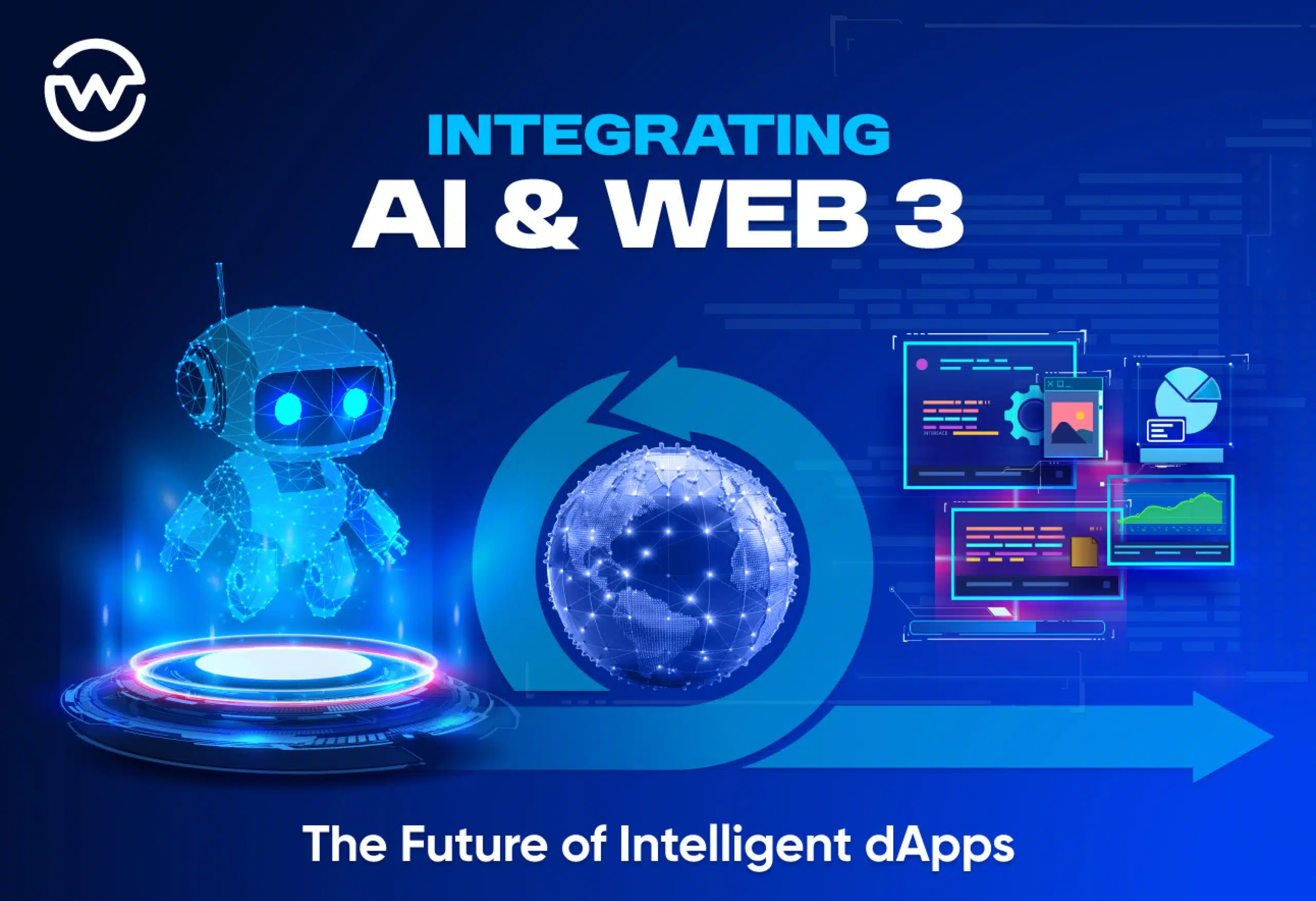
Integrating AI With Web3: The Future of Intelligent dApps
Category : Artificial intelligence, WEB 3.0 / by Andrew
The evolution of the internet to Web3 is remodelling the digital ecosystem by introducing autonomous, user-governed, and decentralised applications. As per Grand View Research, the Global Web 3.0 market size is projected to reach USD 33.53 billion by 2030, due to its growing impact across industries. What makes this shift even more powerful is the synergy of Web3 with emerging technologies, especially Artificial Intelligence.
AI brings intelligence, automation, and learning capabilities, while Web3 provides transparency, user empowerment, tamper resistance, and decentralisation to the business applications. Together, they assist in building dApps that are not only smart but also self-governing and adaptive. Let’s understand this dynamic of AI in Web3 in detail in this article.
Understanding Web3 And AI Technology
What is Web3?
Commonly referred to as “the next generation of the internet,” Web3 has evolved from its predecessor, Web 2.0. This innovative technology is allowing businesses to switch from traditional centralised platforms to decentralised ones, which is why it is also known as the decentralised web.
Web3 technology-based applications run on distributed blockchain networks that deliver data control to users and facilitate secure as well as transparent transactions. Web3 is constituted of core components: blockchain technology, cryptocurrencies, smart contracts, NFTs, and DAOs that assist in building secure, decentralised, transparent, and user-governed next-gen ecosystems.
What is AI?
In simple words, Artificial Intelligence (AI) technology enables computer systems to think, act, and even learn like humans. Tasks that were earlier just meant for humans can be easily carried out with the help of AI. These include understanding natural language, recognising speech, analysing large datasets, identifying patterns, learning from experiences, and making smart decisions accordingly.
AI operates by employing machine learning, computer vision, generative AI, and natural language processing to fuel trading bots, smart assistants, self-driving cars, cybersecurity systems, and any other digital experiences.
Also Read: Top 8 Profitable Play-to-Earn Web3.0 Games in 2025
Role of AI Integration in Web3
Web3 itself is a groundbreaking technology, but when coupled with AI, it produces highly intelligent and next-generation applications capable of easily understanding complex information, automating operations, and predicting the correct outcomes.
Here is the complete breakdown of what role AI plays in Web3 dApp development:
Distributed Data Analysis and Personalisation
The decentralised nature of Web3 applications removes the need for centralised servers, and data is distributed across network nodes. AI technology thrives on data, and in order to gather this data, it employs edge computing, zkML (Zero-Knowledge Machine Learning), federated learning, and privacy-centric algorithms like differential privacy, homomorphic encryption, etc. Due to these advanced techniques, these models easily gather data and train even across distributed nodes without compromising user privacy or data ownership.
Now, using these AI-powered Web3 networks allows easy detection of fraudulent or irregular transactions across DeFi platforms. Furthermore, NFT blockchain gaming platforms or marketplaces can employ AI to detect behavioural patterns and improve user experience. Even simple dApps can personalise the user experience with machine learning models.
Predictive Analytics and Proactive Ecosystems
AI technology possesses predictive analytics capabilities, which operate by collecting information through comprehensive data analysis and identifying recurring patterns to ultimately forecast the most probable outcomes. As a result, AI integration makes dapps more anticipatory.
DeFi protocols in decentralised finance applications assist in predicting liquidity shortages by analysing the token pool and rebalancing pools to maintain high liquidity at all times. Likewise, GameFi Web3 ecosystems optimise reward allocation to increase user engagement and retention. These predictive models can even detect anomalies in advance, reducing system failures and increasing the strength of Web3 decentralised applications.
Autonomous Decision-Making
Smart contracts act as the backbone of Web3. They help automate agreements by meeting preset conditions and enabling rule-based decisions. Incorporating AI with Web3 enhances smart contract automation by adding adaptability, learning skills, and intelligence to transactions, rather than just following strict rules. Machine learning and reinforcement learning in AI use platform user experience and emerging trends to create more intelligent automated contract logic.
Even AI-powered DAOs can examine market sentiment and digital asset volatility before taking action. In addition, AI technology can be used to monitor market data and oracles in order to change the logic of smart contracts. For example, consider a smart contract for a supply chain dApp that uses predictive demand models to adjust inventory or reroute logistics.
Secure Decentralised Ledgers
Web3 decentralised applications consist of a distributed ledger that records the network transactions, which are immutable to any change or deletion. AI’s analytical abilities enhance the security of distributed ledgers by developing more secure and unhackable systems. They even assist in dealing with common system threats like Sybil attacks, rug pulls, smart contract exploits, and more.
Anomaly detection algorithms monitor blockchain transactions and alert on suspicious patterns. Not only that, these decentralised networks gain self-repairing capabilities as AI technology reroutes data traffic during system overload to avoid node failure. Developers can use AI technology during Web3 application development to audit smart contracts, identify vulnerabilities, and resolve them efficiently.
Popular Use Cases of AI in Web3 dApps
There are numerous use cases for AI adoption to create highly innovative and intelligent Web3 decentralised solutions for various industries. Here are some of the examples:
AI-Powered Risk Management in Web3 DeFi platforms
AI-driven security systems help detect fraud in DeFi by mitigating a variety of threats and vulnerabilities.
For example, the latest tools, such as Chainalysis and CipherTrace, detect suspicious patterns and anomalies in real time. Similarly, Compound and Aave are testing various approaches using AI-powered modules to reduce liquidation events and stabilise overall platform liquidity.
AI-Powered Crypto Trading Bots
Trading bots use artificial intelligence algorithms to access, gather, and analyse market and historical data in order to predict and execute profitable trades on behalf of traders. This AI-powered crypto bot trading is extremely useful for practising complex arbitrage trading in highly volatile markets.
Numerai, Covalent, and SingularityDAO use artificial intelligence to provide predictive analytics features on their platforms, allowing users to maximise returns on cryptocurrency trading.
Identity Verification With AI Capabilities
Web3, although it focuses on user sovereignty, user identity verification is also essential to avoid any issues and maintain security without involving centralised authorities. By combining AI with Web3 decentralisation capabilities in dApps, identity systems can be powered with immutability, zero-knowledge proofs (ZKP), and biometric AI to securely verify identities even while preserving privacy all along.
Civic and SelfKey are blockchain-based identity systems that use artificial technology to secure their DeFi platform onboarding and ensure compliance with KYC (Know Your Customer) protocols.
Decentralised Autonomous Organisations (DAOs)
Decentralised Autonomous Organisations (DAOs) utilise smart contracts to collectively make important decisions for running decentralised applications (dApps). However, large-scale human voting and complete proposal management can be time-consuming and biased. To address these issues, artificial intelligence (AI) improves DAOs’ operations by analysing and optimising governance models, as well as automating decision-making processes. This integration makes DAOs more efficient, data-driven, and unbiased. For example, Aragon is incorporating artificial intelligence modules to improve governance fairness on its platform.
Common Challenges Of AI In Web3 dApp Development
Along with the numerous opportunities, AI integration in Web3 presents some challenges as well. However, there have been improvements in addressing these issues. Developers should consider the key obstacles to AI adoption in dApps and actively work to minimize them during Web3 application development:
- AI algorithms employ a lot of computational power to collect and analyse datasets and learn and predict outcomes. It slows down the entire system and places a great deal of strain on dApps’ infrastructure.
- Interoperability of dApps is pivotal for transparent communication and better collaboration in the Web 3 space. However, it is difficult to ensure interoperability in AI-powered Web3 dApps.
- The regulations governing AI and Web3 are not clear. As a result, it becomes more complicated to conduct legal operations while avoiding noncompliance issues.
- In decentralised AI, it can be tricky to strike a balance between the sovereignty of blockchain technology and the data collection by AI models while safeguarding user privacy.
Wrapping Up
Ergo, it is quite evident that the fusion of the biggest technologies of this era, Web3 and AI, delivers smarter decentralised applications. AI technologies can effectively address minor challenges in Web3, but developers may face issues when they integrate AI into Web3 application development incorrectly. Webcom Systems is the top Web3 Development Company in Australia that assists businesses in leveraging the capabilities of AI and building intelligent, secure, and scalable decentralised applications. Interested in learning how we do it? Contact us today to explore the future of Intelligent dApps.
Also Read: Can Blockchain and AI Work Together?
Related Posts
Webcom Systems Pty Ltd is a technology development and consulting company that builds blockchain, Web3, digital currency, NFT, DeFi, remittance, and related software solutions. Our role is strictly limited to providing software development, technical architecture, and strategic consulting services. We do not provide financial, investment, brokerage, exchange, asset management, taxation, legal, or trading services to businesses or individuals. We do not operate financial institutions, manage client funds, execute trading operations on behalf of users, or offer investment, tax, or legal advice of any kind.
Any legal compliance, license, regulatory approval, government registration, permit, KYC/AML implementation, and any other statutory obligation must be obtained and managed entirely by the client. Webcom Systems Pty Ltd does not assist in obtaining licenses or regulatory approvals from any authority.
All information provided on our website, marketing materials, proposals, and communications is for general informational purposes and does not contain investment, legal, or financial advice specific to you. You may rely on this information strictly at your own risk. No particular piece of information issued by us constitutes a proposal or request for a proposal to invest. We do not recommend, endorse, or sponsor any assets, securities, companies, or funds.
Clients are entirely responsible for conducting independent due diligence and are professionally advised to seek assistance from licensed financial advisors, legal counsel, and regulatory professionals to make such critical choices. Webcom Systems Pty Ltd accepts no liability for any decisions or financial consequences of your investment decisions.
Risk WarningInvesting and trading in financial markets involve a high level of risk. The value of financial products may fluctuate significantly, and you may lose part or all of your invested capital. It is preferable to fully comprehend how different financial products work before making any investment decisions. You should also carefully evaluate your financial situation, investment goals, and risk tolerance, and consider all risks involved before investing.
Error: Contact form not found.